Taking content designed for a desk-based user experience and displaying it on a place-based screen meant for an audience more than 10 feet away is stupid a common mistake made by many DOOH practitioners.
A good real-time social feed for events or venues needs to:
a) Attract attention
b) Sustain interest
c) Be easily readable by the entire intended audience.
I’d like to address these points using a real example of a feed used at one of our very own industry’s key events, last weeks DPAA Media Summit event in NYC (which I wrote about here).
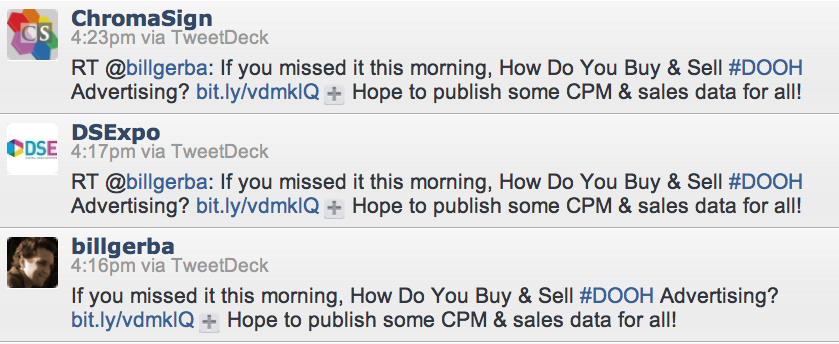
The screen shot below (taken from my Hootsuite setup) is similar to the initial experience that greeted me on a Twitter screen at last week’s DPAA event. I was sitting a third of the way from the front, in an audience of around 400 people.
There are good reasons why that type of design is not great for an event-based or digital out-of-home application.
While it was well placed to attract attention, being on stage, the execution was poor in relation to it’s ability to sustain interest (which I’ll come back to) and it completely failed with regards to its ability to be read by most of the audience.
I tweeted that I couldn’t read the tweets.
As the tweets shuffled up, the new (attention grabbing) message only commanded around 15% of the screens’ real estate. Not only is that insufficient real estate to grab and keep an audience’s attention, but it’s also competing with 5 other older messages, commanding around 85% of the screen, with the same weight as the new message.
To the credit of the person managing the DPAA’s Twitter screen, they noticed my message and responded by decreasing the number of tweets to 3.
That was an improvement but it didn’t solve the problem.
From the screen shot below (again taken from Hootsuite, not from the DPAA screen, but in any case, similar in structure to the DPAA Twitter screen experience) you can see that the attention grabbing new message now has around 30% of the screen real estate. This is better but it’s still competing with 2 other messages, equally weighted, and commanding about 70% of the screen.
Sustaining an audience’s attention is not only related to content and graphics it’s also related to the predicability of the program or timeline. For example, a news ticker may grab initial interest, but after a few seconds, it’s crawl becomes predicable.
The human brain is designed to pay most attention to the newest movement and sound. Long ago, those changes in movement or sound might have been life threatening. Once we recognize the movements, we can process them and, if they are not life threatening, we tune them out. (That’s why we don’t notice the continuous hum of an air conditioning system until it’s turned off.)
That might be good for our safety but not for DOOH applications.
The screen shot below shows a LocaModa Twitter screen. The difference is hopefully obvious. It’s been designed (and patented) specifically for venue and event screens, is attention grabbing, attention sustaining, easy to assimilate by the entire audience and fun.
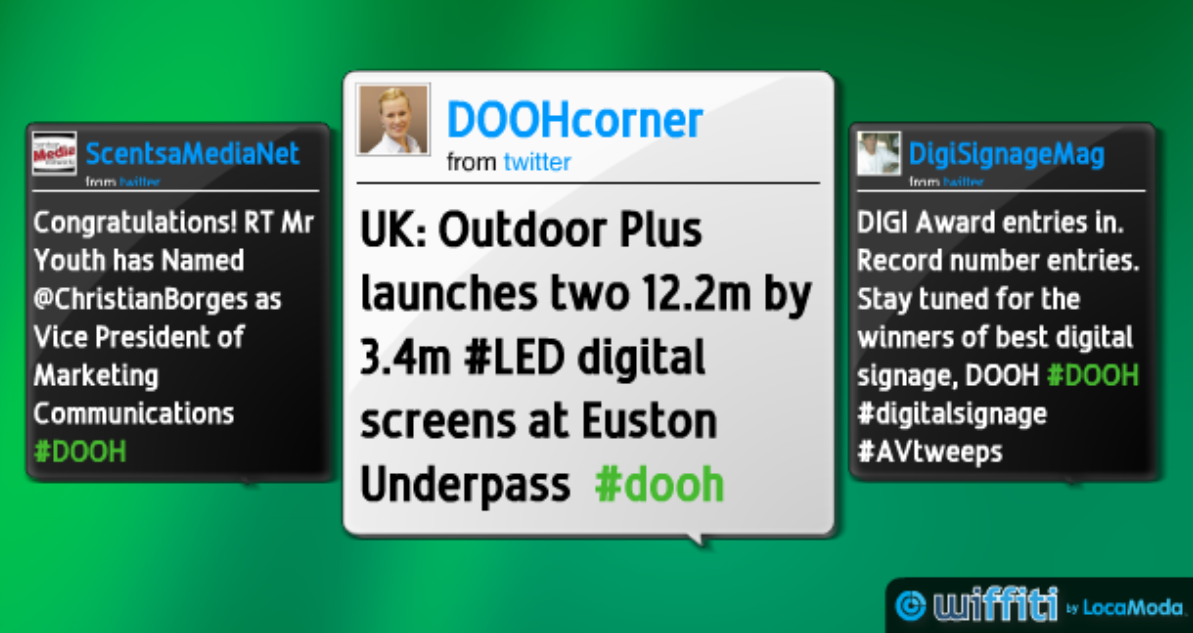
The newest message is displayed almost full screen for a few seconds (enough time to notice and assimilate the content) commanding at least 75% of the screen real estate, then it settles into a dominant screen position.
The new message default configuration is the inverse of older messages - new messages typically set to a dark font on a light background. Older messages are smaller, and typically set to a light font on a dark background. Whilst readable, older messages are designed to NOT compete with the new message - they are really used to convoy the flow of messages and activity rather than give them equal status and weight to the new message.
The messages deliberately do not have a predictable movement - they jostle to find their right screen position based on their size and that also provides a sustainably engaging experience for the entire audience, not just the front row.
Less is more.
Big is beautiful.
Content is king - if you can see it.





Tags: Digital Out-of-Home, digital signage, DOOH, Facebook, Interactive, interactive advertising, interactive digital signage, interactive media, Interactive Media Platform, LocaModa, location based services, location-based, place-based media, Social Media, Social Networks, Stephen Randall, user-generated content, Wiffiti


Leave a Reply