Looking for something?


Posts Tagged ‘interactive media’

The DOOH Audience Is mobile so it’s really important that as DOOH practitioners, we understand our audience’s mobile behavior before we get seduced into investing/designing in sexy mobile technologies. But with our ADD generation, often limited to 140 characters, the mobile UX is frequently an afterthought.

Apple, and before them Nokia, really understand (or understood in the case of Nokia) what mobility meant BEFORE designing mobile solutions.

When we humans are mobile, our experience is often focused on an activity that, if interrupted, stops our mobility in its tracks. We could be walking, driving, playing, shopping etc and if interrupted, that interruption better be for a good reason.

A mobile app (ignoring how it’s discovered) should ideally complement a dominant mobile activity. But if it has to interrupt mobile behavior, it has to offer a compelling enough reason for the user to break away from that activity.

As a designer of a mobile experience, if you don’t think about how, when and why an interrupt-driven message will and can be received, you will almost certainly fail.

Is your user standing in line, pushing a shopping cart, carrying a bag, driving, drinking, watching a concert? How much dwell time do they have to notice, act, react, interact? In many cases, the answer is 15-60 SECONDS (see this post on how UX maps to different types of locations and engagement models).

Now work out if your shiny new smartphone app, NFC app, QR code or text messaging CTA are worthy of interrupting your audience. Now sanity-check that your execution includes giving the user enough time AND benefit (e.g. “The 3Fs” Fun, Fame and Fortune, also covered in the above linked post) to engage.

I hope this interruption to your daily reading was worth while. If it was, please Tweet about it. It is wasn’t, I guess I’ve proven a point - because if it’s not even worth your while to click on a simple Twitter icon, how sobering is it to think about engaging your users?

Share

The integration of place-based media with mobile and social technologies is consistently in the top five predictions for the future of our industry. Yet very few companies have wrestled with the realities of integrating these technologies at scale.

Even the simplest social media application can trip up inexperienced companies hoping to leverage user-generated content or streams publicly.

For example, a user might be delighted to check-in to a place using a location-based service such as Foursquare and receive “offers nearby” but the location owner will not be so happy!

Similarly, Tweets that can be displayed on a location’s screen should not have URLs that can’t be clicked on, multiple retweets of the same message or messages that are offensive.

Place-based versions of such apps have to benefit the location as well as the consumer - for example, only displaying appropriate offers for the specific location and displaying filtered and localized tweets.

Solving such problems for single locations is waaaay easier than solving the problem for 100’s or 1,000’s of venues, each with different engagement rules – but all expecting real time media and responsiveness.

At this years Digital Signage Expo, in Las Vegas, Feb 22-25th, LocaModa will be releasing LocaModa 4.0 which builds on our company’s experience delivering the world’s first place-based versions of Twitter, Facebook Places and Foursquare for global brands, place-based networks and advertising agencies. And as you might expect, it specifically addresses the above challenges for licensees with a few venues or a few thousand venues to manage.

LocaModa’s booth is 1032. We hope to see you there!

Share

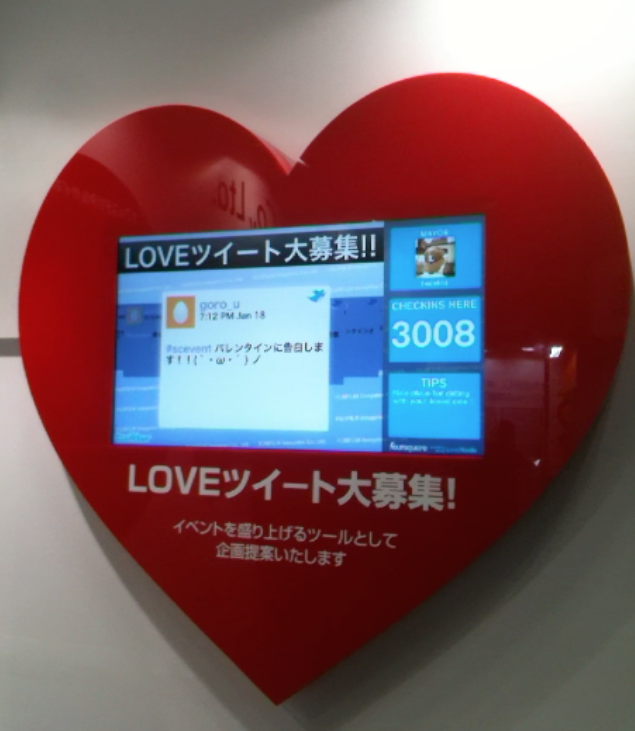
Thanks to our partners Fujifilm Imagetec for this great photo of LocaModa’s Foursquare and Twitter in Japan.

Share

Click picture to enlarge

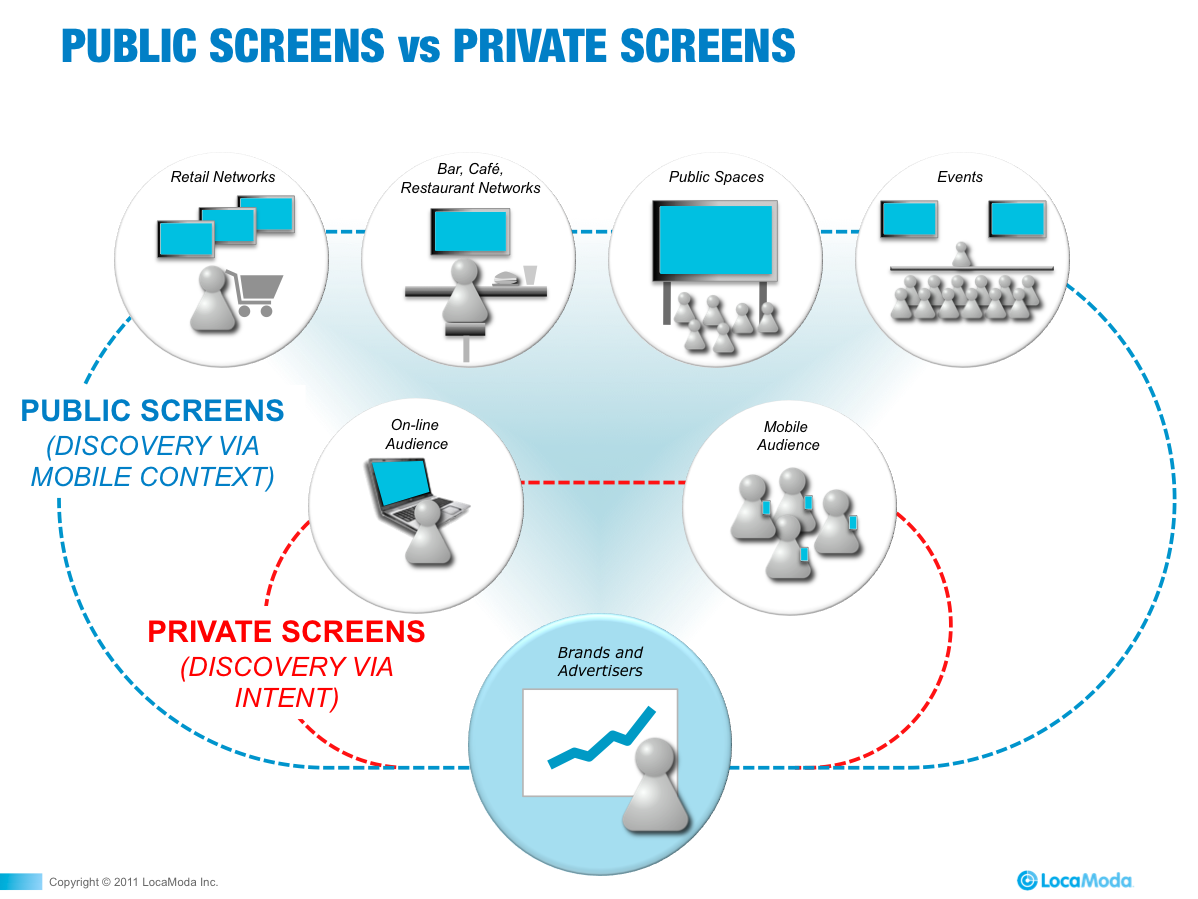
Not all screens are created equal. I’m not talking about the whiz-bang of 3D or electronic ink, or flexible LEDs or other tantalizing technologies. I’m talking about the connective tissue that relentlessly reduces the friction for media to find a screen near you.

The money is in the HOW and WHO controls the access rights for media to find us.

On private screens, such as PCs or mobile screens, users’ access to media is broadly via search or browsing links - in other words it’s driven by a user’s INTENT. A marketer cannot force their way in front of a user’s face without hoping to influence their intent or be paying (e.g. Google or Facebook) for the results of their intent.

On a public screen, such as a place-based digital screen, access to media is broadly via a user’s “MOBILE CONTEXT” - mobile in this sense is not a technology but a behavior - shopping, meeting, traveling, drinking, waiting etc. Subject to a user’s mobile context, marketers can force their way in front of the user’s face BUT that does not give them permission to go any further. There is no automatic path (push) to a user. The user has to have the intent to pull the marketer’s message in.

Connecting these two paradigms; intent-based screens to mobile-context-based screens is how to unleash the latent value in the DOOH ecosystem.

Share

Scan to see if this QR is BS

After more than 15 years in mobile technology, it’s easy to notice a pattern where a mobile acronym is sometimes promoted as if it was a cure for cancer. Result? Unmet expectations and a sense that mobile is hyped - or simply doesn’t work.

I’ve just read an article in Retail Customer Experience about the use of QR codes in DOOH and have to call out the simple and glaring fact that it’s complete BS.

I hope that the technology was misunderstood rather than being hyped - but it’s still a problem for folks in DOOH pitching anything “mobile” as it can only confuse or disappoint customers who might now expect something from QR codes that they will never get.

In layman’s terms, a QR code (QR stands for Quick Response) is simply a method of getting a webpage’s url from a static object like a poster, to a user. They’re cool for sure, but according to the article, QR codes now have interactive, 2-way, location-based qualities.

Claim #1:(In relation to the company’s QR application.) “And since the phone is aware of location and who you are and the time and the weather and the city you’re in, we can actually send very specific location-based information to that particular user.”

Why Claim #1 is BS: Even when a phone is aware of your location, applications don’t automatically get that information. Even when applications have access to local/personal information, the user has to agree to that information being accessed.

Claim #2: Kombi and EnQii showcased the ability for their app to “announce” to a store that an individual consumer is approaching, “and have that influence what’s happening on the digital screens in the store and have the screens be able to push back to the phone synchronized offers,” turning the consumer’s smart phone into “an intimate interaction device.”

Why Claim 2 is BS: This is nothing to do with QR codes, is really misleading and is illegal without the users explicit permission. I wrote about this in my post Minority Report Is Not The future Of Advertising.

Claim #3: Now retailers and marketers will be able to use rule-based, one-on-one communications with the consumer that is based on knowing, not guessing, who the consumer is, where they are and what they need, while also using the correct language, lifestyle imagery and loyalty discount if applicable, Eisenhauer says.

Why Claim #3 is BS: There is no way of knowing WHO the user is simply via a QR code being scanned. The user needs to opt-in to a promotion and give permission to the marketer to user their info.

In my humble opinion, a QR code might be a sexier way to promote an URL but it is not A two-way integration of digital signage and mobile (which was the title of the post).

QR codes and DOOH might not even be good bedfellows: When used in DOOH, a QR code requires a fair amount of time and real-estate on a screen - because the user needs to see (and be close enough to scan), recognize and be motivated to scan the code - and have a phone and application capable of scanning the code. Allow at least 30 seconds for that process (See my post, 15-seconds-or-more-part-2 on the place-based mobile user experience). A simple url can be equally tracked and would need no more than 5-10 seconds to read and remember.

Now don’t get be wrong - I love these technologies - but I spend a reasonable portion of most client meetings undoing hype and clarifying misinformation.

Bottom line - it’s might be cool to scan a QR code, visit a website on your phone, wave it around at your friends or show it to the person on the register to redeem an offer. But sometimes it’s easier for the marketer to display Go To WWW.WEBSITE.COM/OFFER to get your offer.

Share