Click picture to enlarge
Not all screens are created equal. I’m not talking about the whiz-bang of 3D or electronic ink, or flexible LEDs or other tantalizing technologies. I’m talking about the connective tissue that relentlessly reduces the friction for media to find a screen near you.
The money is in the HOW and WHO controls the access rights for media to find us.
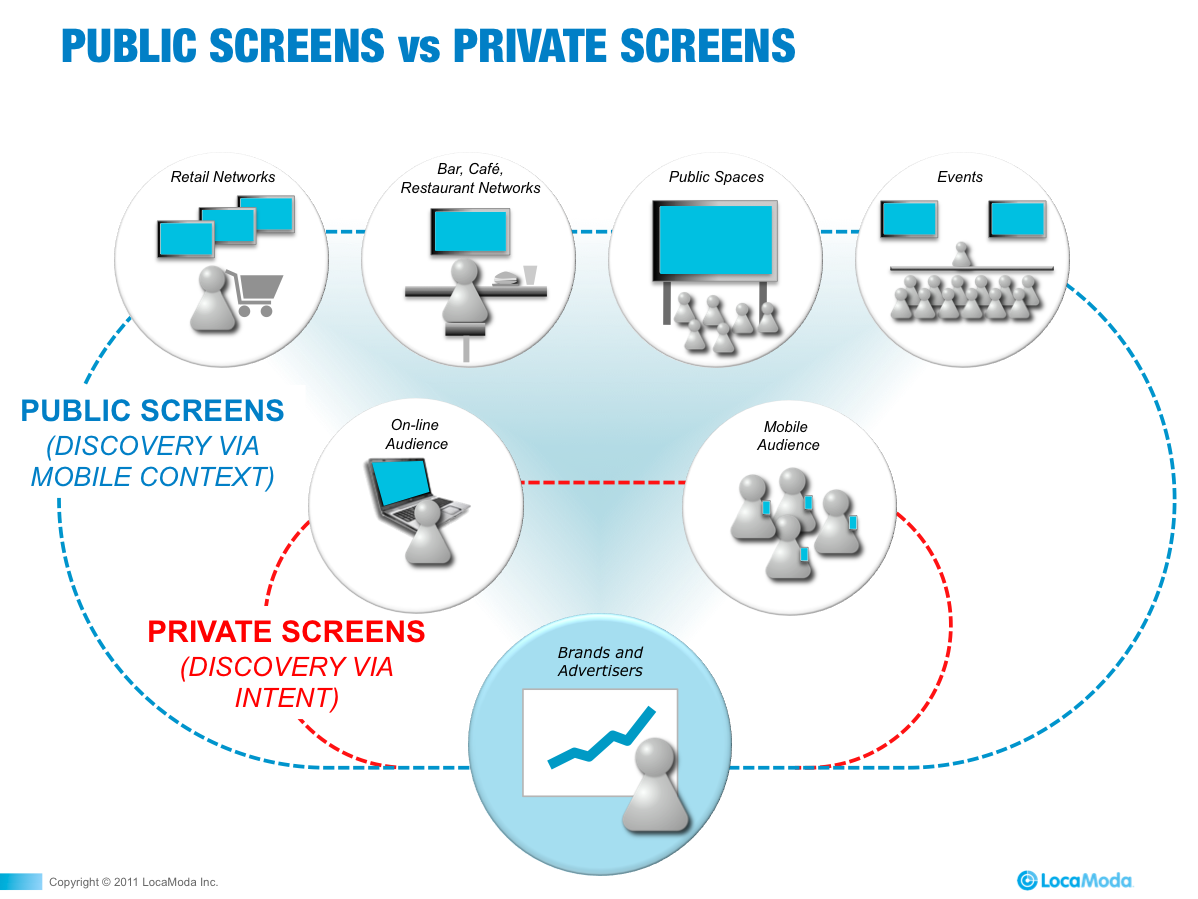
On private screens, such as PCs or mobile screens, users’ access to media is broadly via search or browsing links - in other words it’s driven by a user’s INTENT. A marketer cannot force their way in front of a user’s face without hoping to influence their intent or be paying (e.g. Google or Facebook) for the results of their intent.
On a public screen, such as a place-based digital screen, access to media is broadly via a user’s “MOBILE CONTEXT” - mobile in this sense is not a technology but a behavior - shopping, meeting, traveling, drinking, waiting etc. Subject to a user’s mobile context, marketers can force their way in front of the user’s face BUT that does not give them permission to go any further. There is no automatic path (push) to a user. The user has to have the intent to pull the marketer’s message in.
Connecting these two paradigms; intent-based screens to mobile-context-based screens is how to unleash the latent value in the DOOH ecosystem.





Tags: cross channel campaign, Digital Out-of-Home, digital signage, DOOH, Facebook, foursquare, interactive advertising, interactive digital signage, interactive media, Interactive Media Platform, LocaModa, place-based media, place-based networks, place-based social media, Social Media, social media platform, Stephen Randall, twitter


Leave a Reply