Looking for something?


Posts Tagged ‘digital signage’

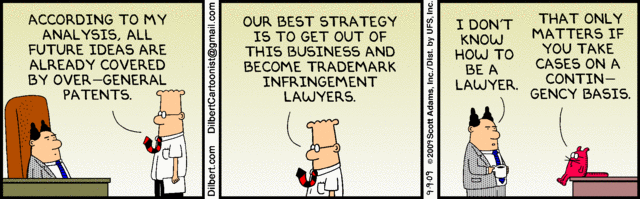
I’m fond of saying that a patent is like a poker hand. You can win a game of poker with a great hand and you can also bluff and win with bad hand, but you can’t win with no hand. So patents, even bad ones, can sometimes generate a win for their owners, even when they are at best dubious.

I received an email this morning regarding the invention and recent granting of a patent for a “cellphone changing an electronic display that contains a barcode”.

I know some folks think I’m opinionated about some things, especially when it comes to the use of QR Codes in DOOH, so it will come as no surprise if I say (again) that:

Putting an oh-too-small QR code on digital signage for oh-too-little time and ooh-too-far-away is a waste of pixels!

Even if a user can draw their phone from their pocket faster than the Lone Ranger AND have a QR Code app ready to launch AND and be close enough to the screen scan the code BEFORE the campaign spot changes, the campaign better deliver something so damn valuable that it pays for someone (not counting anyone at the network, brand or the agency) to do exactly that.

AND even if a patent application for doing exactly that kind of thing was applied for in say May 2011 , I’m surprised the patent office didn’t site prior art AND GRANTED PATENTS from 2004 that disclose:

A system and method of interactive, location based and presentation and advertising that enables users with wireless network addressable communications device to control multi-media content on network addressable screens and enables marketers to track, monitor and respond to users interactions in real-time. A Proxy Gateway directs a network addressable client PC, connected to a digital display, to serve a local content or pull content from one or more web servers. A wireless, network addressable device, typically a mobile phone, is used to communicate commands to the physically remote Proxy Gateway, The proxy Gateway bridges between the communications device, forwarding them to the client PC which may pull content from the appropriate web server or display native message content.

Even ignoring the above IP, leading “practitioners in the field” continue to leverage interactive OOH/DOOH techniques proven to engage the casual onlooker. I guess the patent office doesn’t read search the DailyDOOH or other stalwarts of our digital signage industry.

Share

Last week LocaModa was seen powering Twitter walls for Politico at the Republican National Conference. And this week, of course, it’s the turn of the Blues, again via Politico, at the Democratic National Conference.

There have been several write ups about our bipartisan involvement with Democratic-leaning SKDKnickerbocker and Republican-leaning firm McLaughlin & Associates and we are delighted to see the fruits of their work at these major national events.

Summarizing what our friend Gail from DailyDOOH reported a few days ago, politics and DOOH make good bedfellows - I’m avoiding the urge to insert a joke in very poor taste here :)

Share

Last week Jason Kates wrote An Open Letter to the Digital Out-Of-Home Industry.

Jason has his detractors, but he’s been in the industry longer than most of us and has deep experience (and war wounds) of all the problems we still stubbornly have in our industry. He’s been a platform guy, a signage guy, a network guy and most recently, an ad platform guy. He’s smart, and understands the influence of the web on media. Something not enough people in DOOH do. He might not be completely right about Social TV, but I suspect he’s not completely wrong. So I prefer to look at what he might be right about.

Many people misunderstand what interactivity in DOOH means. Outside of touch screens, it is rarely about literally interacting in front of a screen. Of course a screen can trigger interaction, but that is by far the less common case for engagement. And if that literal version of interactivity is what people think about when they dismiss social engagement, they are barking up the wrong tree.

Most DOOH doesn’t have the dwell time or spot length for engagement. There are exceptions (bars and sports stadiums) but they are unlikely to be business cases for the next Google.

Interactivity to me at least (and to the growing number of people not focused on DOOH, but on screens that engage regardless of acronym) means that there’s some pulse somewhere on a network. When someone interacts, that interaction, be it a fan, a follow, a tweet, a text, a photo, a game play, a song play etc, can be reflected on multiple screens to help those screens be more interesting. A passive screen might then display What’s Playing Here, Who’s Here Now, What’s On Offer, What’s Happening…

A screen that doesn’t do this is dead. Dead to audiences, dead to advertisers and dead to investors.

That’s why TV is trying to redefine itself. At least it’s trying! And that’s why DOOH needs to do the same.

If DOOH practitioners don’t understand the scope and potential of 360 degree interactivity, they will have a blind spot for how social and mobile actually impact DOOH.

Ken Goldberg gets it right here in my opinion.

We have to find better ways to make DOOH relevant.

Let’s not get (conveniently) distracted by the definition of Social TV - it already means different things to different people. I am confident that companies like Bluefin Labs could disrupt Neilson. I am also confident that Twitter and Facebook will be mainstays of DOOH content (when done right and not infringing patents!)

So, assuming we all have a healthy respect for an argument, I do not agree with our favorite Brit (well he has more followers than me) Adrian Cotterill, when he tweeted his response to Jason’s open letter that “SocialTV is kinda orthogonal to the whole DS/DOOH issue I have never ever read such RUBBISH…”

Like Mr Kates, I suspect Adrian is not completely right. There’s more to Social TV than 140 characters can say.

Share

I am a speaker in what’s been billed an “Interactive Shootout” at 9.00 am, Thursday March 8th at DSE.

Details here

The fight debate will take a deeper look at the realities of interactive technologies and will (if I’m anything to do with it) cut the crap to expose the good bad and ugly.

This will be a no pitch zone, warts ‘n all, crash course for the red hot area of how adding the words “mobile” “social” or “local” to DOOH, might or might not mean a damn.

To help expose the BS and provide an engaging and provocative learning experience, I will be joined by two of the brightest and non-BS people in our industry - David Haynes (Sixteen:Nine blog, pressDOOH and The Preset Group) and David Weinfeld (Digital Signage Insights blog and CSO at Screenreach).

David Weinfeld and I will take opposing sides of each question lobbed at us by Mr Haynes - we may not even know which side we’ll be asked to take until Mr Haynes directs us - that way, the audience will gain perspective into the pros and cons of otherwise hyped areas of our industry.

I’m confident that attendees will leave with a rounder sense of the challenges and opportunities - rather than a sales pitch. And if we can save anyone from getting at any of the war wounds that we have got in the past 10+ years of DOOH, then it’ll be time well spent.

Hope to see you there.

Share

When LocaModa launched Wiffiti some 4 years ago, it was designed as an engagement tool for audiences to express themselves on screens at events or venues.

Wiffiti continues to serve us well and has been used in several hundred campaigns (with brands such as Pepsi, Coke, Verizon, GM etc) political events (such as a fund raiser for the then presidential candidate Barack Obama) and events/concerts (including major trade shows such as CES, American Idol tours and the Black Eyed Peas).

But a strange thing started to happen about 18 months ago.

Where LocaModa was focused on monetizing media on digital out-of-home screens, our platform unpredicatbly started to be embraced by teachers.

Like brands, teachers realized that their “audience” wasn’t always paying attention! Instead of telling their pupils to turn their phones off, enterprising teachers recognized the potential to use the phone as an engagement tool and communication channel.

What may well have started out as a “cool” idea or gimmick worked, and soon we saw tens of thousands of screens being made by users who were not exactly LocaModa’s target customers.

Today over 90,000 Wiffiti applications have been made by teachers.

Scolastic even published a lesson on text messaging in class via Wiffiti.

And that is why we not only had to listen to the wisdom of the crowd, but also work out where new markets for Wiffiti could be.

So today at Wiffiti.com, there is an invitation to a beta program that is being rolled out in the coming weeks to the many thousands of teachers, event/conference organizers and smaller digital networks who have been outside our core market.

The key features that teachers have been asking for have previously only been available to customers paying many thousands of dollars - but those features including the ability for a screen to be private and moderation tools, will soon be available to a much wider group of users.

And for event/conference organizers, who need more flexibility to customize screens to market to their audiences, there will be affordable Wiffiti Pro versions.

Our media clients and digital networks have a very different set of requirements for customized campaigns and/or hundreds or thousands of localized nodes, and these clients will be unaffected by the changes going on with Wiffiti. They will soon be offered a range of applications and features more easily tailored to their specific requirements.

So stay tuned - and if you want an invite to the Wiffiti beta program, you can get one here.

Share