Looking for something?


Posts Tagged ‘location based services’

Taking content designed for a desk-based user experience and displaying it on a place-based screen meant for an audience more than 10 feet away is stupid a common mistake made by many DOOH practitioners.

A good real-time social feed for events or venues needs to:

a) Attract attention
b) Sustain interest
c) Be easily readable by the entire intended audience.

I’d like to address these points using a real example of a feed used at one of our very own industry’s key events, last weeks DPAA Media Summit event in NYC (which I wrote about here).

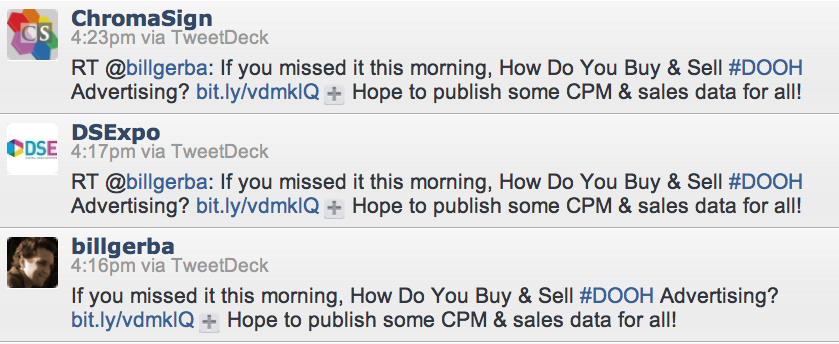
The screen shot below (taken from my Hootsuite setup) is similar to the initial experience that greeted me on a Twitter screen at last week’s DPAA event. I was sitting a third of the way from the front, in an audience of around 400 people.

There are good reasons why that type of design is not great for an event-based or digital out-of-home application.

While it was well placed to attract attention, being on stage, the execution was poor in relation to it’s ability to sustain interest (which I’ll come back to) and it completely failed with regards to its ability to be read by most of the audience.

I tweeted that I couldn’t read the tweets.

As the tweets shuffled up, the new (attention grabbing) message only commanded around 15% of the screens’ real estate. Not only is that insufficient real estate to grab and keep an audience’s attention, but it’s also competing with 5 other older messages, commanding around 85% of the screen, with the same weight as the new message.

To the credit of the person managing the DPAA’s Twitter screen, they noticed my message and responded by decreasing the number of tweets to 3.

That was an improvement but it didn’t solve the problem.

From the screen shot below (again taken from Hootsuite, not from the DPAA screen, but in any case, similar in structure to the DPAA Twitter screen experience) you can see that the attention grabbing new message now has around 30% of the screen real estate. This is better but it’s still competing with 2 other messages, equally weighted, and commanding about 70% of the screen.
Sustaining an audience’s attention is not only related to content and graphics it’s also related to the predicability of the program or timeline. For example, a news ticker may grab initial interest, but after a few seconds, it’s crawl becomes predicable.

The human brain is designed to pay most attention to the newest movement and sound. Long ago, those changes in movement or sound might have been life threatening. Once we recognize the movements, we can process them and, if they are not life threatening, we tune them out. (That’s why we don’t notice the continuous hum of an air conditioning system until it’s turned off.)

That might be good for our safety but not for DOOH applications.

The screen shot below shows a LocaModa Twitter screen. The difference is hopefully obvious. It’s been designed (and patented) specifically for venue and event screens, is attention grabbing, attention sustaining, easy to assimilate by the entire audience and fun.
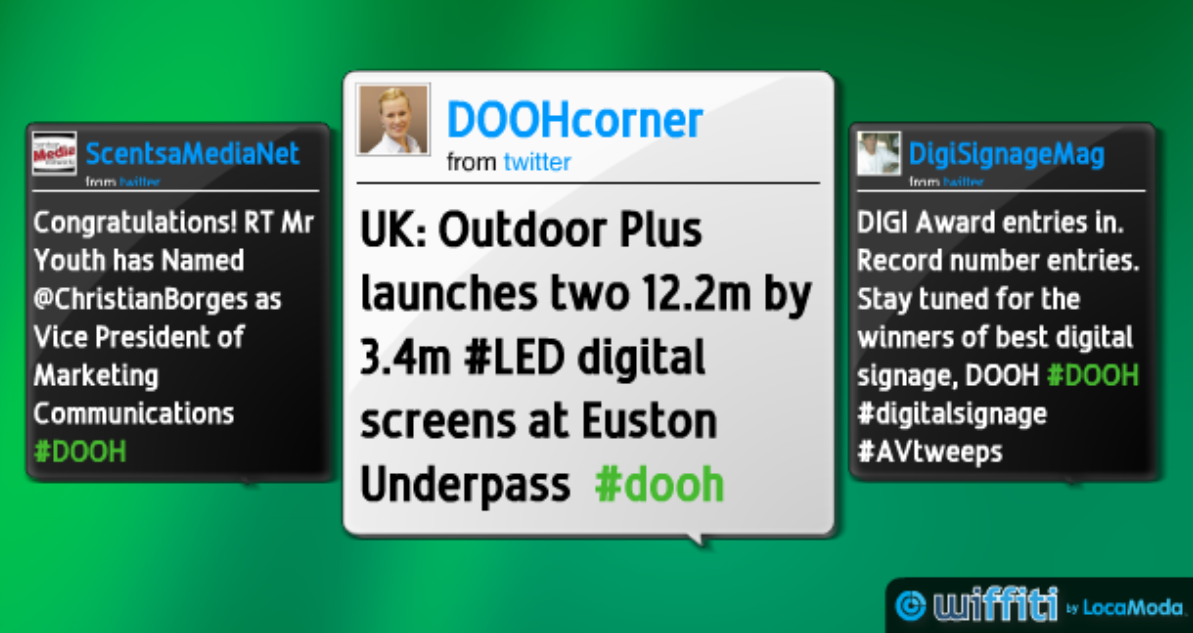
The newest message is displayed almost full screen for a few seconds (enough time to notice and assimilate the content) commanding at least 75% of the screen real estate, then it settles into a dominant screen position.

The new message default configuration is the inverse of older messages - new messages typically set to a dark font on a light background. Older messages are smaller, and typically set to a light font on a dark background. Whilst readable, older messages are designed to NOT compete with the new message - they are really used to convoy the flow of messages and activity rather than give them equal status and weight to the new message.

The messages deliberately do not have a predictable movement - they jostle to find their right screen position based on their size and that also provides a sustainably engaging experience for the entire audience, not just the front row.

Less is more.

Big is beautiful.

Content is king - if you can see it.

Share

The DOOH Audience Is mobile so it’s really important that as DOOH practitioners, we understand our audience’s mobile behavior before we get seduced into investing/designing in sexy mobile technologies. But with our ADD generation, often limited to 140 characters, the mobile UX is frequently an afterthought.

Apple, and before them Nokia, really understand (or understood in the case of Nokia) what mobility meant BEFORE designing mobile solutions.

When we humans are mobile, our experience is often focused on an activity that, if interrupted, stops our mobility in its tracks. We could be walking, driving, playing, shopping etc and if interrupted, that interruption better be for a good reason.

A mobile app (ignoring how it’s discovered) should ideally complement a dominant mobile activity. But if it has to interrupt mobile behavior, it has to offer a compelling enough reason for the user to break away from that activity.

As a designer of a mobile experience, if you don’t think about how, when and why an interrupt-driven message will and can be received, you will almost certainly fail.

Is your user standing in line, pushing a shopping cart, carrying a bag, driving, drinking, watching a concert? How much dwell time do they have to notice, act, react, interact? In many cases, the answer is 15-60 SECONDS (see this post on how UX maps to different types of locations and engagement models).

Now work out if your shiny new smartphone app, NFC app, QR code or text messaging CTA are worthy of interrupting your audience. Now sanity-check that your execution includes giving the user enough time AND benefit (e.g. “The 3Fs” Fun, Fame and Fortune, also covered in the above linked post) to engage.

I hope this interruption to your daily reading was worth while. If it was, please Tweet about it. It is wasn’t, I guess I’ve proven a point - because if it’s not even worth your while to click on a simple Twitter icon, how sobering is it to think about engaging your users?

Share

Well, the start of Q4’11 has been really hectic.

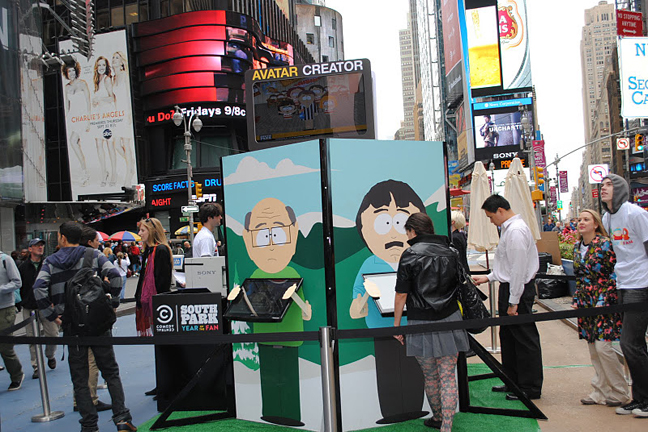
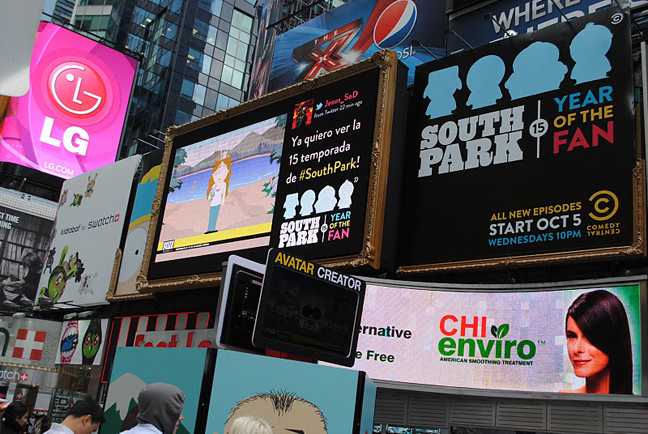
Not only were we honored to be participating at the Robin Hood event with Black Eyed Peas in Central Park, but we were also chosen to be the interactive social platform behind a launch campaign for South Park’s new series which kicked off yesterday in New York’s Times Square.

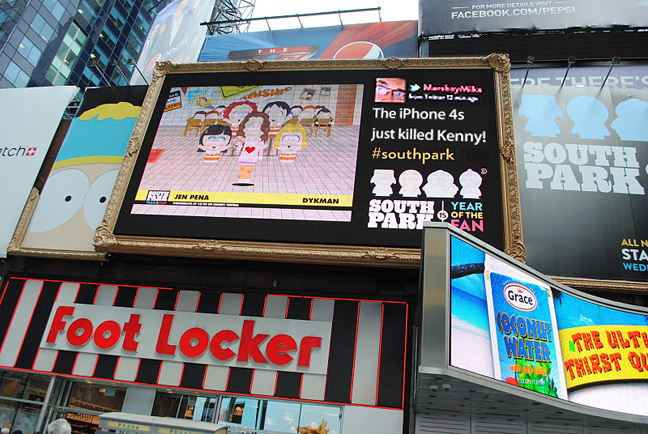
Times Square visitors could create a South Park avatar of themselves at an interactive kiosk, and then see their avatar displayed live alongside real time tweets (hashtagged SOUTHPARK) on the famous MTV/Viacom screen in Times Square.

And of course, unless you were asleep, yesterday also marked the announcement of the much anticipated iPhone5 ahem iPhone4s.

Place-based social media is ALL ABOUT CAPTURING THE MOMENT AND LETTING THE AUDIENCE ENGAGE, so the last photo in the set here just about sums it up. A tweet proclaims “The iPhone4s killed Kenny”.

Share

So few Location-Based Marketing platforms have been built for real-world applications.

As location-based applications from Foursquare, Facebook, Google and others have gained attention, most locations have been somewhat frustrated by how much effort is needed to embrace these platforms.

Limited functionality and/or complexity has thus far led to results that have not lived up to the red hot hype. For example, it is really difficult to create messages and/or deals for multiple locations without having to go into each location’s account - which can be too time consuming for larger retail groups. And in a business where 15 minutes spent on a website is 15 minutes not spent stocking shelves or hiring a waiter, simplicity and RoI count for more than “cool.”

So it’s good news that this week saw both Foursquare and Facebook update their interfaces for merchants.

Foursquare has been on a roll - raising $50 million, partnering with AMEX for deals, and this week, opening up their API for locations to be able to create their own deals via any platform (LocaModa for example - shameless plug). So now venues can use one interface (LocaModa for example - another shameless plug) - to create/edit/monitor their offers. More info via Foursquare here.

Facebook updated Facebook Pages with a Location feature and introduced a Deals API. The new Facebook Locations tab displays the “parent/child” relationship of claimed Facebook Places locations in one place. This means that large groups of stores (Parents) can change all their pages in one interface while still enabling a single store (child) to control their own messaging. More info via Facebook here.

This is all welcome news BUT it’s still likely that for the foreseeable future, brands and location owners won’t quite know what to put on their location pages or Facebook walls. The experience greeting many users may therefore still be rather underwhelming at best. A blank wall at worst.

(Drum roll) THAT’S AN OPPORTUNITY FOR DOOH.

We know how much time and effort has been spent on creating local content and information for screens in the locations - menus in cafes, announcements in health-clubs, deals in stores etc. This content can now more easily flow back to Foursquare and Facebook - as well as enabling any content created on those platforms finding its way to the location signage.

From a DOOH perspective, I like to say that screens need to have a range of miles, not feet. With a screen connected to Facebook or Foursquare (or Twitter et al), a screen can reach many more people and be more contextually interesting to the local audience, an on-line audience and advertisers. And connected DOOH screens are ever more measurable via the interactions of these audiences.

Thinking about a “Build or Buy” decision for a DOOH-ready social-media platform? It should more obvious than ever that this is a full time business with API changes from social media companies happening almost in real time - and in order to monetize the technology, the solution not only needs to be robust, extensible and scalable, but also needs to be network agnostic to attract brands who need to be wherever their target audience is.

As locations join the social graph, their technologies - not least the screens hanging on their walls - simply have to become more socially connected.

Share

A client just sent us their creative for a call to action on a forthcoming LocaModa campaign. Without giving away any names or clues, their call to action was something like “Text AYT9Q31628ZB for a chance to win…” To make matters worse - this CTA is to be displayed for 8 seconds.

Coincidently, at the same time as people here were pulling their hair out and trying to jump off ledges, I was reading this line in a blog post “Anybody who has looked at their customer acquisition funnel knows how even minor usability problems can drive away vast swaths of people.”

Sometimes I want to shoot myself in the head. It usually happens around the time a client is shooting themselves in the foot.

Share