Looking for something?


Posts Tagged ‘user-generated content’

Companies using social media to connect to people and places need to support the multiple tools and methods that their audiences use. However, if you were to ask 10 media savvy users how they send an update with a photo attachment, you’d probably get more than 10 answers.

LocaModa now supports even more interaction models via mobile or web using email, txt, Twitter and more….

For example, we support all the strange things that mobile phone email clients do, such as unusual MIME structures, or including the numeric mumbo-jumo that many carriers have implemented and include in their email subject lines. So friendly.

If a message includes a URL or short URL which looks like it might point to an image, we can display that image (assuming the message passes our filters and the image is moderated).

We also support a whole host of photo sharing apps on Twitter clients including yFrog (which also supports video), TwitPic, Lockerz, TweetPhoto, Instagram, img.ly, Lightbox and can display JPEG, PNG, BMP, TIFF and GIF images.

We also get requests from customers that want their audiences to be able to email directly to local screens. Every LocaModa-enabled screen has a unique address such as JOESBAR. This address can also be used as an email address for example [email protected]. In this case, any text in the email’s subject line can be copied into the body of the Wiffiti message. That method can also be used to email a photo to a screen, with the photo’s caption being the email subject line.

Some of this might seem a little geeky, but we now enable networks with over 30,000 venues and our platform has also enabled 80,000 Wiffiti screens for events, as well schools and churches, so we’ve given up being surprised by what our customers want to do with our platform.

If there’s a feature that you want and we don’t support, we’d be happy to consider it for our roadmap (but if it’s too esoteric you might need to bring your checkbook!).

Share

Taking content designed for a desk-based user experience and displaying it on a place-based screen meant for an audience more than 10 feet away is stupid a common mistake made by many DOOH practitioners.

A good real-time social feed for events or venues needs to:

a) Attract attention
b) Sustain interest
c) Be easily readable by the entire intended audience.

I’d like to address these points using a real example of a feed used at one of our very own industry’s key events, last weeks DPAA Media Summit event in NYC (which I wrote about here).

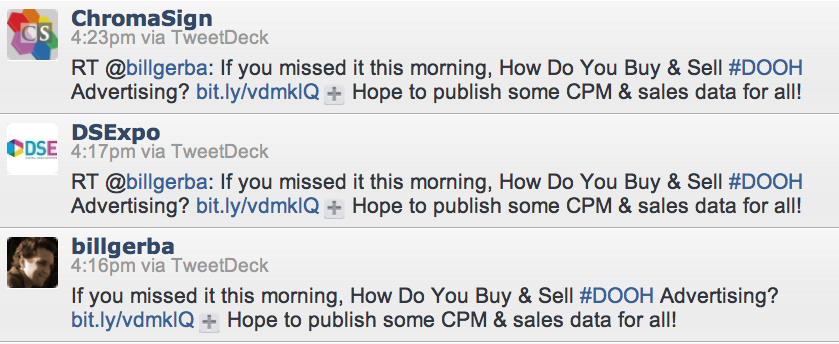
The screen shot below (taken from my Hootsuite setup) is similar to the initial experience that greeted me on a Twitter screen at last week’s DPAA event. I was sitting a third of the way from the front, in an audience of around 400 people.

There are good reasons why that type of design is not great for an event-based or digital out-of-home application.

While it was well placed to attract attention, being on stage, the execution was poor in relation to it’s ability to sustain interest (which I’ll come back to) and it completely failed with regards to its ability to be read by most of the audience.

I tweeted that I couldn’t read the tweets.

As the tweets shuffled up, the new (attention grabbing) message only commanded around 15% of the screens’ real estate. Not only is that insufficient real estate to grab and keep an audience’s attention, but it’s also competing with 5 other older messages, commanding around 85% of the screen, with the same weight as the new message.

To the credit of the person managing the DPAA’s Twitter screen, they noticed my message and responded by decreasing the number of tweets to 3.

That was an improvement but it didn’t solve the problem.

From the screen shot below (again taken from Hootsuite, not from the DPAA screen, but in any case, similar in structure to the DPAA Twitter screen experience) you can see that the attention grabbing new message now has around 30% of the screen real estate. This is better but it’s still competing with 2 other messages, equally weighted, and commanding about 70% of the screen.
Sustaining an audience’s attention is not only related to content and graphics it’s also related to the predicability of the program or timeline. For example, a news ticker may grab initial interest, but after a few seconds, it’s crawl becomes predicable.

The human brain is designed to pay most attention to the newest movement and sound. Long ago, those changes in movement or sound might have been life threatening. Once we recognize the movements, we can process them and, if they are not life threatening, we tune them out. (That’s why we don’t notice the continuous hum of an air conditioning system until it’s turned off.)

That might be good for our safety but not for DOOH applications.

The screen shot below shows a LocaModa Twitter screen. The difference is hopefully obvious. It’s been designed (and patented) specifically for venue and event screens, is attention grabbing, attention sustaining, easy to assimilate by the entire audience and fun.
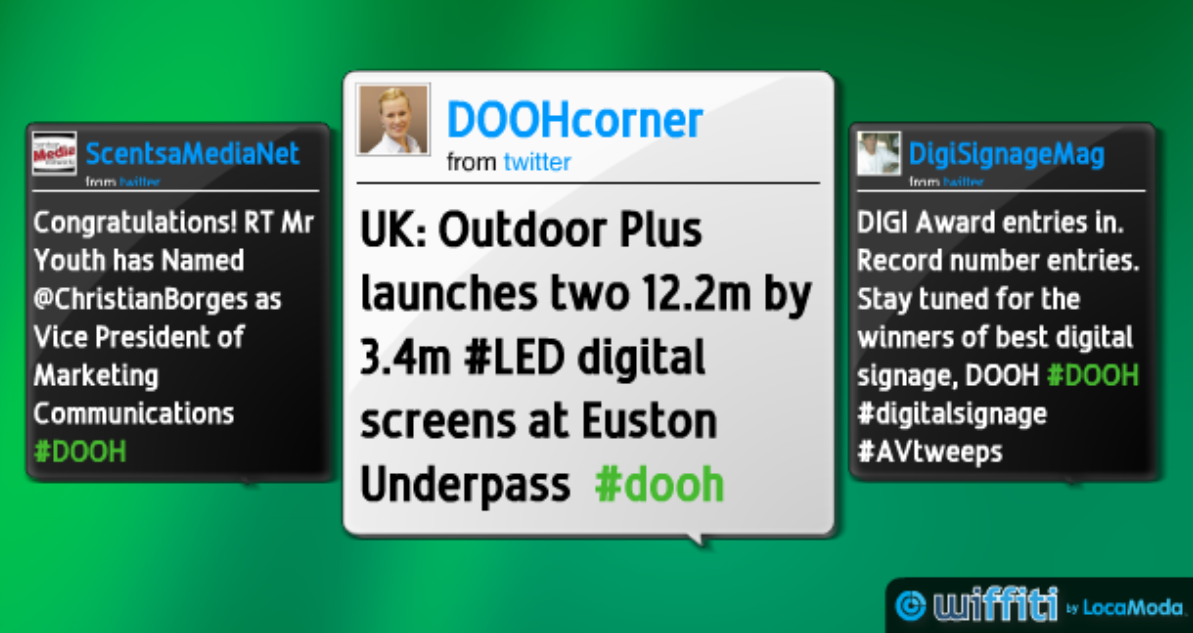
The newest message is displayed almost full screen for a few seconds (enough time to notice and assimilate the content) commanding at least 75% of the screen real estate, then it settles into a dominant screen position.

The new message default configuration is the inverse of older messages - new messages typically set to a dark font on a light background. Older messages are smaller, and typically set to a light font on a dark background. Whilst readable, older messages are designed to NOT compete with the new message - they are really used to convoy the flow of messages and activity rather than give them equal status and weight to the new message.

The messages deliberately do not have a predictable movement - they jostle to find their right screen position based on their size and that also provides a sustainably engaging experience for the entire audience, not just the front row.

Less is more.

Big is beautiful.

Content is king - if you can see it.

Share

A typical call to LocaModa goes something like this (animated version here):

CALLER: “My company is interested in LocaModa’s products.”

LOCAMODA: “Thank you for your interest. Please tell me more about your company.”

CALLER: “We are a digital out of home network focused on (select one: cafes/bars/health clubs/supermarkets/hospitals/waiting rooms/QSRs/public spaces/cinemas…)”

LOCAMODA: “Sounds interesting. How large is your network?”

CALLER: “We are rolling out nationally.”

LOCAMODA: “OK. How many locations are you in today?”

CALLER: “We will have over 1,000 within 12 months.”

LOCAMODA: “How many do you have installed today.”

CALLER: “We have commitments for 1,000.”

LOCAMODA: “How many are actually deployed today?”

CALLER. “We’re just closing our funding for the full roll out.”

LOCAMODA: “So do you have any screens deployed today?”

CALLER: “Later this month we’re starting the pilot.”

LOCAMODA: “So you don’t actually have any screens deployed today?”

CALLER: “We’re all seasoned entrepreneurs and we’re confident that we’ll hit out targets and we have a very solid business model and…..”

LOCAMODA: (Genuinely) “Good luck with the funding and the pilot. We’d love to talk to you when you have a minimum of 50 screens in a major market.”

We used to be less discriminating about spending time developing every lead, after all, who knows which opportunity will be the next big deal? But do you know how many how many of those “about to fund/roll-out 1,000 nationally” calls actually did what they said they were going to do?

None. Correction - one :)

Experience has to teach us something - and for me, it’s simply that to be a good partner, we must focus our resources on deals that have a real chance of success - especially as we’ll inevitably be committing opportunity costs and resources to helping make that success a reality.

So last week when someone tweeted:

“So @LocaModa looks awesome but man it is expensive. Per screen cost is fine, but requiring a minimum of 50 screens to start? #DOOH #DOOHWTF”

We retweeted it because, yes, we think the product is awesome. And yes we agree the per screen cost is fine. And yes, we require our licensees to be of sufficient size (a minimum of 50 screens in a key market).

Share

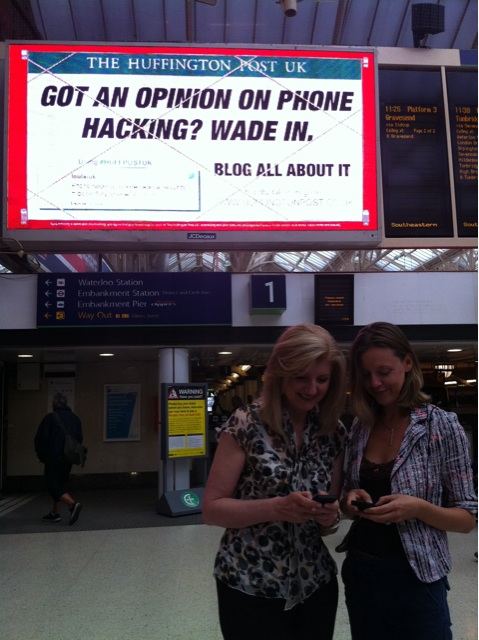
The photo above shows Arianna Huffington, President and Editor-in-Chief of the Huffington Post Media Group with Carla Buzasi, Editor-in-Chief of Huffington Post UK. They’re at Charing Cross Station, London, tweeting to a LocaModa-enabled screen, running a real-time place-based social media campaign for the launch of Huffington Post UK.

I didn’t realize until last week that traditional street hoardings in UK are not familiar things to folks on this side of the pond. The memory of a guy with ink-stained fingers shouting something completely unintelligible to commuters is all part of British daily life. So I was really happy that LocaModa was asked to develop a place-based social media version of a newspaper street hoarding for Huffington’s Post’s UK launch this week.

The creative, like its traditional counterpart, features a live bold headline which grabs attention, and a moderated real-time tweet, hashtagged #HuffPostUK which helps emphasize the new media chops of the brand, as well as suggest to the viewer that this “poster” isn’t what it might first appear to be.

I’m not sure if I’m allowed to mention all the players involved in this campaign - but I would like to thank them all for the excellent team work, especially as much of the back-room work was unfolding during the July 4th weekend over here.

The campaign is running prominently in major train stations all over the UK. Another trip down memory lane for me as I used to commute to Waterloo Station every day when I was at Symbian and Paddington Station (where the bear comes from) is over the road from St Mary’s Hospital where I was born. Keeping it real.

Share


Click to enlarge

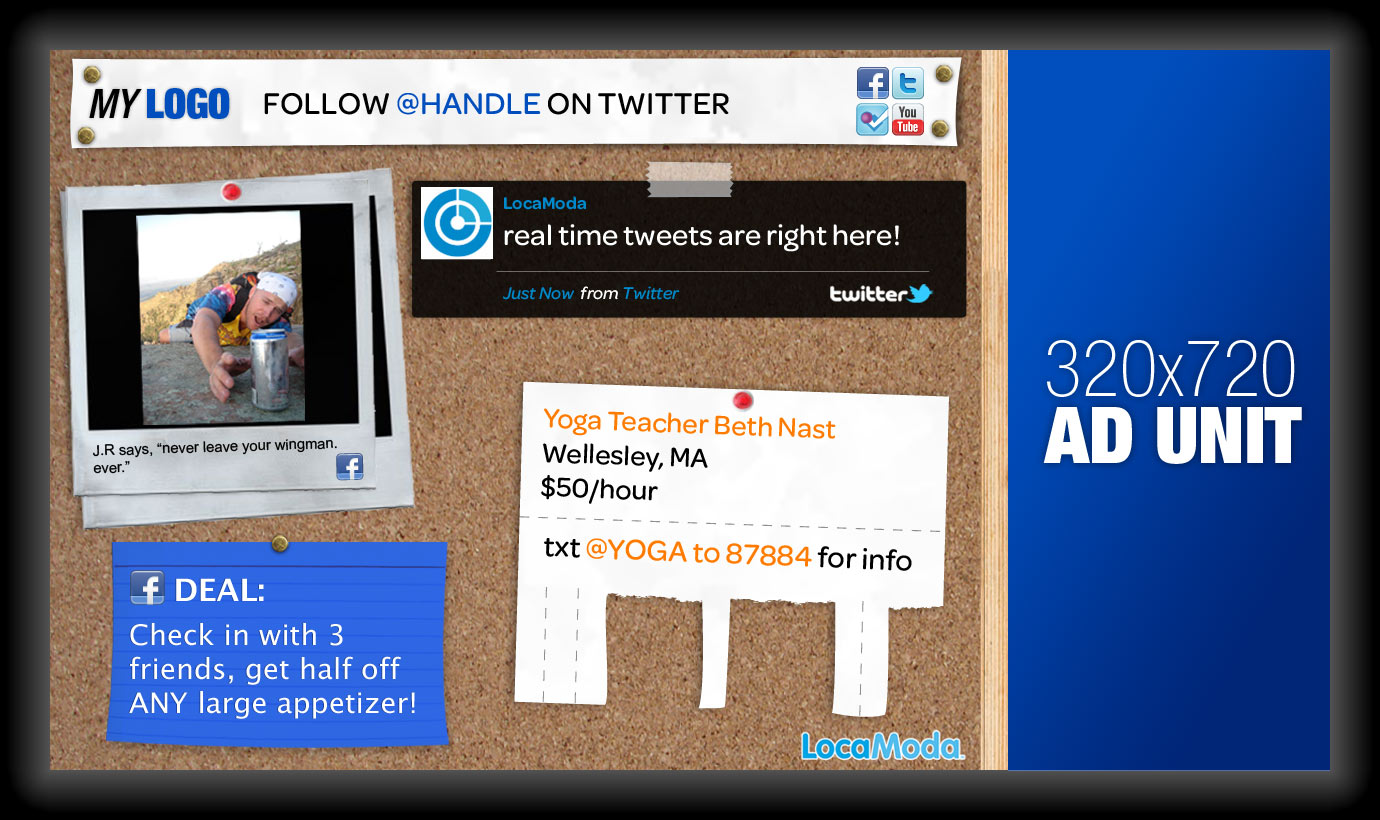
I rarely use this blog to blatantly plug LocaModa products, but I’m really excited about LocaModa Community Board, an application that we launched today. A link to the PR is at the end of this post, but I think there’s a more important strategic angle unfolding in the DOOH market that can’t be told in a product press release - so I wanted to blog about it here.

There are over 300 DOOH content management systems (CMSs).

That’s a problem that would get in the way of any market taking off.

Let’s be honest, brands, agencies and retailers really couldn’t care less about CMSs. And they certainly don’t want to have to wrestle with more than one. They want simple, non-proprietary, scaleable solutions. Ideally, a designer wants to build it once and know it can run everywhere.

We’ve been here before. The Internet took off with the invention of the browser which was simple, powerful and useful and provided a unified interface on top of proprietary operating systems.

I think a similar strategy has to unfold in DOOH to enable more frictionless distribution and greater scale. And I hope (for LocaModa’s strategic value) that it will happen via Community Board.

Community Board is also simple, powerful and useful and provides a unified interface on top of proprietary operating systems.

The value of community boards is in their connection to real people. A digital version of a community board takes a familiar metaphor and enables locations and brands to reach those communities. Packaging a DOOH application this way, makes it easier to understand by the entire value chain. It provides a utility that venue owners and brands can relate to. Brands can also be confident that their ad units (passive, active or interactive) will work in a consistent manner on all community boards, regardless of network capabilities. And community boards have a place and value in multiple verticals - health clubs, grocery stores, pharmacies, retail, offices, cafes, quick serve restaurants…

Very few companies are as focused on making DOOH applications and ad units work across multiple networks, multiple CMS, multiple channels - That’s what LocaModa has been resolutely focused on. As more and more DOOH networks seek mobile + social + local solutions in order to engage audiences and attract interactive media dollars (i.e. survive) they MUST adopt non-propriatary solutions. Simply put, even the largest networks cannot operate as islands.

LocaModa Community Board is launching nationally on six networks and two premier brands have already purchased media for Q3 and Q4. I’m excited for this application and LocaModa - but also because I can see how the DOOH market can grow like the web via such unifying applications.

Hey, an entrepreneur has to have a BHAG (Big Hairy Audacious Goal) - mine is to enable The Web Outside. I think Community Board is a critical part of achieving that goal.

The official press release is here.

Share