Yesterday, I addressed the difficulty in pinning down metrics for place-based cross-channel campaigns like Vans Be Here.
We can all agree that we’re scrabbling on slippery ground when it comes to crunching numbers. So what do we do about it?
First, locate the reward.
For this campaign, the real payoff for the user is grabbing a snapshot of their photo (or text message) displayed on Viacom’s iconic Jumbotron in Times Square and sharing it with friends.
Now make this step as simple as possible for the user. (In this example, we send them an email with a direct link to their ‘moment,’ and we allow them to spread the photo with a single click.)
Direct Link:
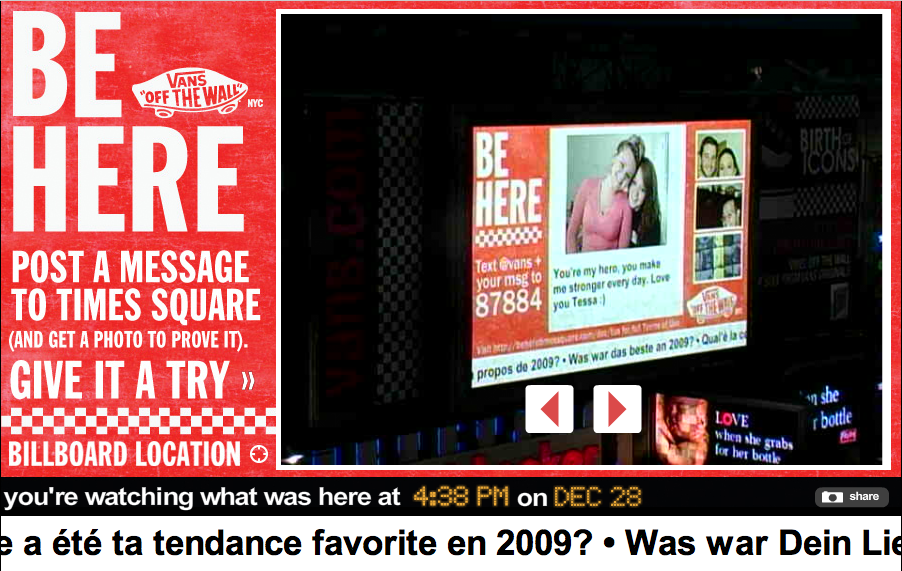
Upon clicking the “Snapshot” button:
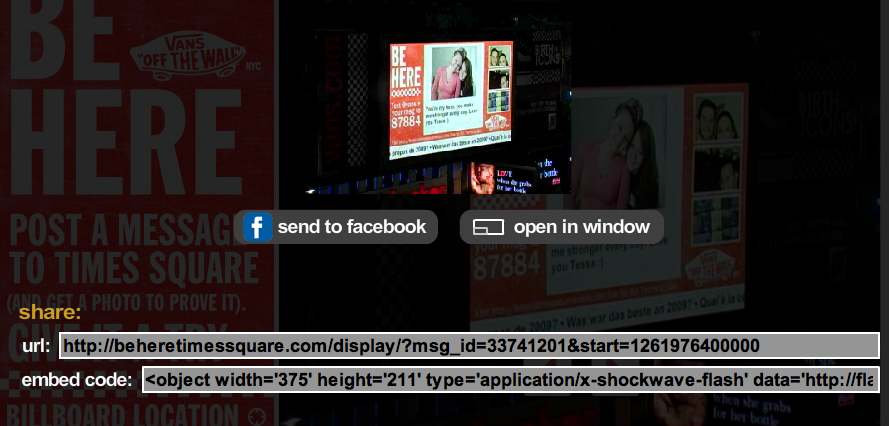
But, what is this interaction exactly?
How do we account for this?; rather, how do we ‘count’ this?
Well, the tricky thing is that this interaction starts with a unique user’s single click, but the real fruit falls when the snapshot is shared. For simplicity’s sake, let’s say the average # of connections for this one user is 126 (the current average # of followers for Twitter users, which seems fair in respect to The Dunbar Number).
So does this count as 1 click and 126 impressions?
Not quite.
What about the out-of-home component? How many eyeballs saw this photo in Times Square? How many people did it affect (passively, subconsciously)?; How many were actually stirred to effect (actively sending in their photo, too)?
Well, if we take into consideration that 1.6 million people pass through Times Square each day (and 500,000 gather there on NYE), then we’ve clearly thrown an exponent into the mix here (though actual computations here are flimsy at best). [src]
A campaign like this must be understood as tracking ‘interaction bundles’ rather than simply impressions or clicks (at the risk of muddying the already murky waters of digital out-of-home vocabulary). The only way to give meaning to numbers here is to qualify rather than quantify:
* Define your verbs (click, txt, view, visit, watch, write, submit, photograph, playback, share, embed)
* Assign worth (find the ‘fruit’)
* Construct goals around collecting as much of this fruit as possible (in this case, getting as many users as possible to share their image with their friends).
Not done yet.
Now calculate the out-of-home spreadability and brand identification piece that’s happening here on a much larger scale than any subset of active users could ever proliferate (no matter how much you subscribe to The Law of the Few).
We end up with a results overview that should remain focused on the brand awareness component, but should also give due credence to the rich ‘interaction bundles’ of the superuser (one who actually employs at least three of these verbs- e.g. visits the site, sees the billboard, sends in content, gets a snapshot, and shares among his social graph).
Have I made you nostalgic for the days of banner ads yet?





Tags: be here, behere, billboard, cross channel campaign, digital out of home measurement, Digital Out-of-Home, digital signage statistics, DOOH, jumbotron, LocaModa, location-based plaform, metrics, place-based media, place-based media metrics, place-based social media platform, statistics, Times Square, Vans, viacom, viral spread


Leave a Reply