Looking for something?


Posts Tagged ‘place-based social media platform’

The DOOH Audience Is mobile so it’s really important that as DOOH practitioners, we understand our audience’s mobile behavior before we get seduced into investing/designing in sexy mobile technologies. But with our ADD generation, often limited to 140 characters, the mobile UX is frequently an afterthought.

Apple, and before them Nokia, really understand (or understood in the case of Nokia) what mobility meant BEFORE designing mobile solutions.

When we humans are mobile, our experience is often focused on an activity that, if interrupted, stops our mobility in its tracks. We could be walking, driving, playing, shopping etc and if interrupted, that interruption better be for a good reason.

A mobile app (ignoring how it’s discovered) should ideally complement a dominant mobile activity. But if it has to interrupt mobile behavior, it has to offer a compelling enough reason for the user to break away from that activity.

As a designer of a mobile experience, if you don’t think about how, when and why an interrupt-driven message will and can be received, you will almost certainly fail.

Is your user standing in line, pushing a shopping cart, carrying a bag, driving, drinking, watching a concert? How much dwell time do they have to notice, act, react, interact? In many cases, the answer is 15-60 SECONDS (see this post on how UX maps to different types of locations and engagement models).

Now work out if your shiny new smartphone app, NFC app, QR code or text messaging CTA are worthy of interrupting your audience. Now sanity-check that your execution includes giving the user enough time AND benefit (e.g. “The 3Fs” Fun, Fame and Fortune, also covered in the above linked post) to engage.

I hope this interruption to your daily reading was worth while. If it was, please Tweet about it. It is wasn’t, I guess I’ve proven a point - because if it’s not even worth your while to click on a simple Twitter icon, how sobering is it to think about engaging your users?

Share

The integration of place-based media with mobile and social technologies is consistently in the top five predictions for the future of our industry. Yet very few companies have wrestled with the realities of integrating these technologies at scale.

Even the simplest social media application can trip up inexperienced companies hoping to leverage user-generated content or streams publicly.

For example, a user might be delighted to check-in to a place using a location-based service such as Foursquare and receive “offers nearby” but the location owner will not be so happy!

Similarly, Tweets that can be displayed on a location’s screen should not have URLs that can’t be clicked on, multiple retweets of the same message or messages that are offensive.

Place-based versions of such apps have to benefit the location as well as the consumer - for example, only displaying appropriate offers for the specific location and displaying filtered and localized tweets.

Solving such problems for single locations is waaaay easier than solving the problem for 100’s or 1,000’s of venues, each with different engagement rules – but all expecting real time media and responsiveness.

At this years Digital Signage Expo, in Las Vegas, Feb 22-25th, LocaModa will be releasing LocaModa 4.0 which builds on our company’s experience delivering the world’s first place-based versions of Twitter, Facebook Places and Foursquare for global brands, place-based networks and advertising agencies. And as you might expect, it specifically addresses the above challenges for licensees with a few venues or a few thousand venues to manage.

LocaModa’s booth is 1032. We hope to see you there!

Share

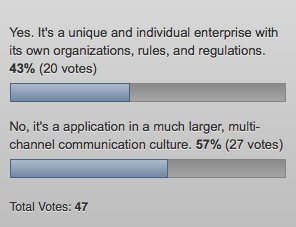
A poll on Experiate last week questioned the designation of ‘industry’ for the digital out of home ideaspace. I quote:

Do we see ourselves as a unique and growing industry with a specific architecture (rules, regulations, trade shows, organizations) that works in tandem with other forms of communication, like our TV at home, computers, and iPhones?

Or do we see ourselves as an application inside a multi-channel communication culture with standards and practices that we should adopt?

The results thus far (from a fairly limited sample set of 47 votes) favor the latter, but only marginally.

David Weinfeld offers his insight on the close tallies:
“Digital signage is an industry, in and of itself; and digital signage is not an industry… Approaching digital signage from the technology side of the equation, it most certainly is an independent sector. [Yet]… When framing digital signage within the world of media, it is but a piece of a much larger ecosystem. In the same way that the word “mobile” will cease to have meaning in an increasingly untethered world, so too will digital signage meld into a world of free flowing media.”

I have to agree with David here… a “yes to both” is really the only way to make sure the relationship among media in the current climate (DS included) is properly represented. The main takeaway here is far less about the semantic designation and far more about developing an evolving set of best practices that both define DS conceptually within the mediascape, while also respecting the unique technical and UX demands required for successful deployment.

Cast your vote here.
It may be time to rally for a write-in option…

Share

So apparently LocaModa CEO Stephen Randall took some time away from karaoke and Beatles cover bands during his recent trip to Japan to stand up as a thought leader in place based social media…

Share

This post is a follow up to Part I: Tips for Displaying Social Media Content on Place Based Screens: Removing URLs and Revealing Backgrounds.

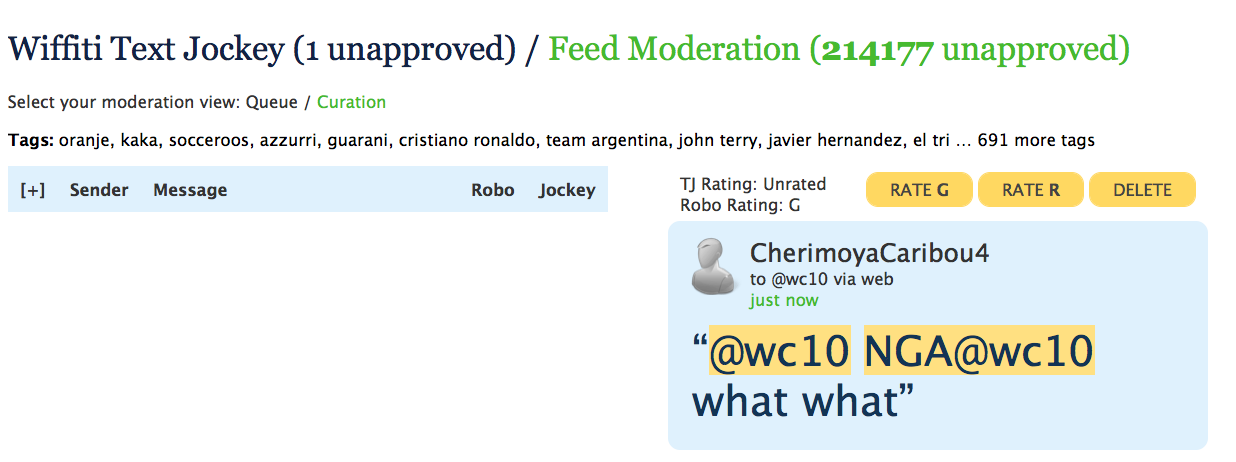
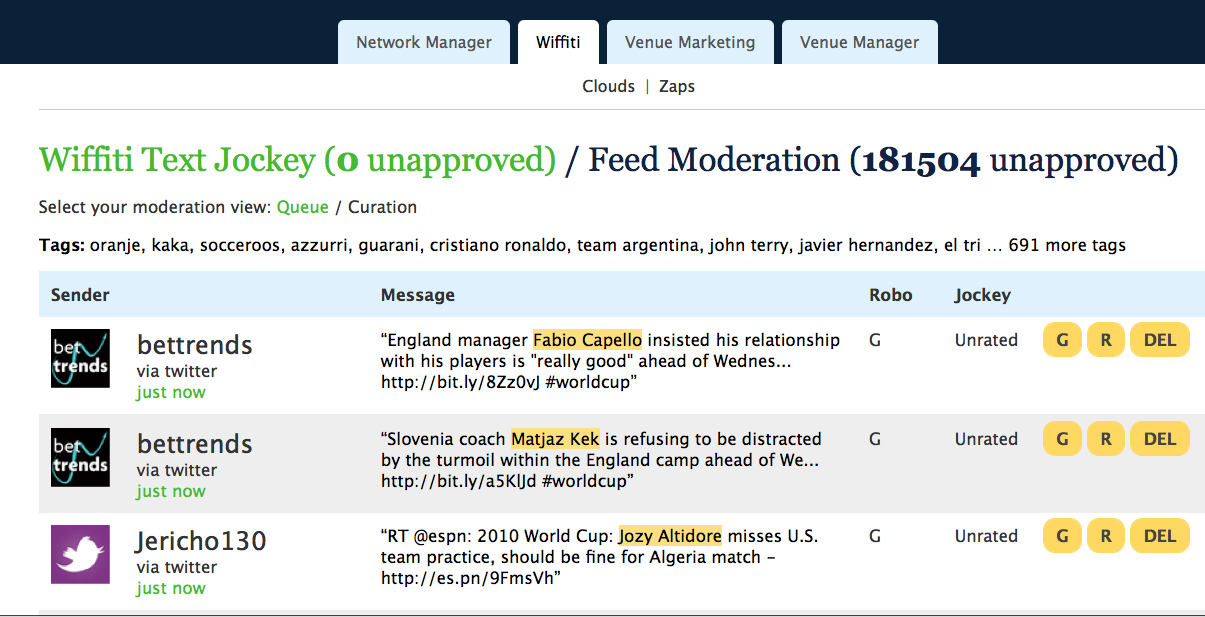
Our current cross-channel campaign for World Cup has proved to be a telling case study for message curation versus message moderation. For text messages and direct-from-web messages, LocaModa relies on a queue view for moderation, in which messages are immediately rated and approved/rejected for display depending upon network, venue and brand guidelines. In the moderation model, messages are handled chronologically by time sent.

However, when we’re looking at the millions of messages tagged #worldcup over the duration of the tournament (300,000 per game and up to 3,000 per second), we’re facing a message saturation level that begs the Moderation Queue to be weeded. We’re no longer in the position where having every message displayed is the best solution; instead, the ability to choose the most relevant and timely messages out of the tens of thousands per hour received becomes a huge boost to the value of the content stream. While on one level hashtags have made it easier to filter content quickly, overused or misused hashtags threaten the integrity of the practice.

That’s where LocaModa flips the switch to Message Curation

In this model, a moderator can quickly sift messages for context and nuance that tags can miss. The goal is to fill the allotted place-based display time with as many quality, campaign-relevant messages as possible, while weeding out the messages that tagging alone couldn’t cull.

For an event with as much social media traffic as the World Cup, message curation proves a necessary step to whittling down the noise.

Now pass me my vuvuzela.

[For more insight on displaying social media content on place-based screens, you can download a full version of LocaModa's recent white paper, "Twitter on Place Based Screens: Why It’s Not So Simple," written by Senior Systems Architect Jacob Elder.]

Share