Looking for something?


Posts Tagged ‘Digital Signage Expo’

A typical call to LocaModa goes something like this (animated version here):

CALLER: “My company is interested in LocaModa’s products.”

LOCAMODA: “Thank you for your interest. Please tell me more about your company.”

CALLER: “We are a digital out of home network focused on (select one: cafes/bars/health clubs/supermarkets/hospitals/waiting rooms/QSRs/public spaces/cinemas…)”

LOCAMODA: “Sounds interesting. How large is your network?”

CALLER: “We are rolling out nationally.”

LOCAMODA: “OK. How many locations are you in today?”

CALLER: “We will have over 1,000 within 12 months.”

LOCAMODA: “How many do you have installed today.”

CALLER: “We have commitments for 1,000.”

LOCAMODA: “How many are actually deployed today?”

CALLER. “We’re just closing our funding for the full roll out.”

LOCAMODA: “So do you have any screens deployed today?”

CALLER: “Later this month we’re starting the pilot.”

LOCAMODA: “So you don’t actually have any screens deployed today?”

CALLER: “We’re all seasoned entrepreneurs and we’re confident that we’ll hit out targets and we have a very solid business model and…..”

LOCAMODA: (Genuinely) “Good luck with the funding and the pilot. We’d love to talk to you when you have a minimum of 50 screens in a major market.”

We used to be less discriminating about spending time developing every lead, after all, who knows which opportunity will be the next big deal? But do you know how many how many of those “about to fund/roll-out 1,000 nationally” calls actually did what they said they were going to do?

None. Correction - one :)

Experience has to teach us something - and for me, it’s simply that to be a good partner, we must focus our resources on deals that have a real chance of success - especially as we’ll inevitably be committing opportunity costs and resources to helping make that success a reality.

So last week when someone tweeted:

“So @LocaModa looks awesome but man it is expensive. Per screen cost is fine, but requiring a minimum of 50 screens to start? #DOOH #DOOHWTF”

We retweeted it because, yes, we think the product is awesome. And yes we agree the per screen cost is fine. And yes, we require our licensees to be of sufficient size (a minimum of 50 screens in a key market).

Share

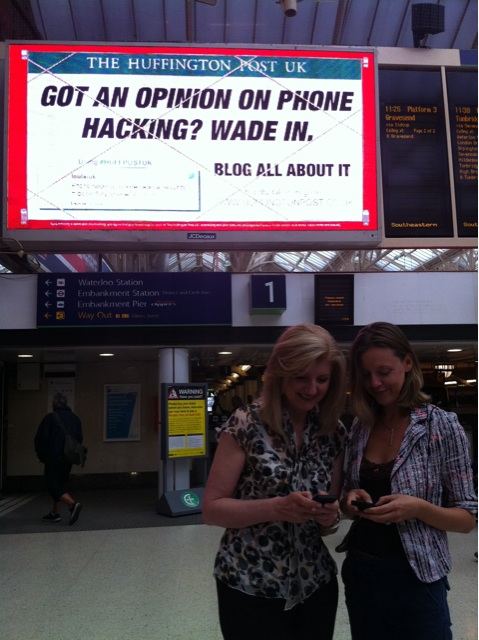
The photo above shows Arianna Huffington, President and Editor-in-Chief of the Huffington Post Media Group with Carla Buzasi, Editor-in-Chief of Huffington Post UK. They’re at Charing Cross Station, London, tweeting to a LocaModa-enabled screen, running a real-time place-based social media campaign for the launch of Huffington Post UK.

I didn’t realize until last week that traditional street hoardings in UK are not familiar things to folks on this side of the pond. The memory of a guy with ink-stained fingers shouting something completely unintelligible to commuters is all part of British daily life. So I was really happy that LocaModa was asked to develop a place-based social media version of a newspaper street hoarding for Huffington’s Post’s UK launch this week.

The creative, like its traditional counterpart, features a live bold headline which grabs attention, and a moderated real-time tweet, hashtagged #HuffPostUK which helps emphasize the new media chops of the brand, as well as suggest to the viewer that this “poster” isn’t what it might first appear to be.

I’m not sure if I’m allowed to mention all the players involved in this campaign - but I would like to thank them all for the excellent team work, especially as much of the back-room work was unfolding during the July 4th weekend over here.

The campaign is running prominently in major train stations all over the UK. Another trip down memory lane for me as I used to commute to Waterloo Station every day when I was at Symbian and Paddington Station (where the bear comes from) is over the road from St Mary’s Hospital where I was born. Keeping it real.

Share


Click to enlarge

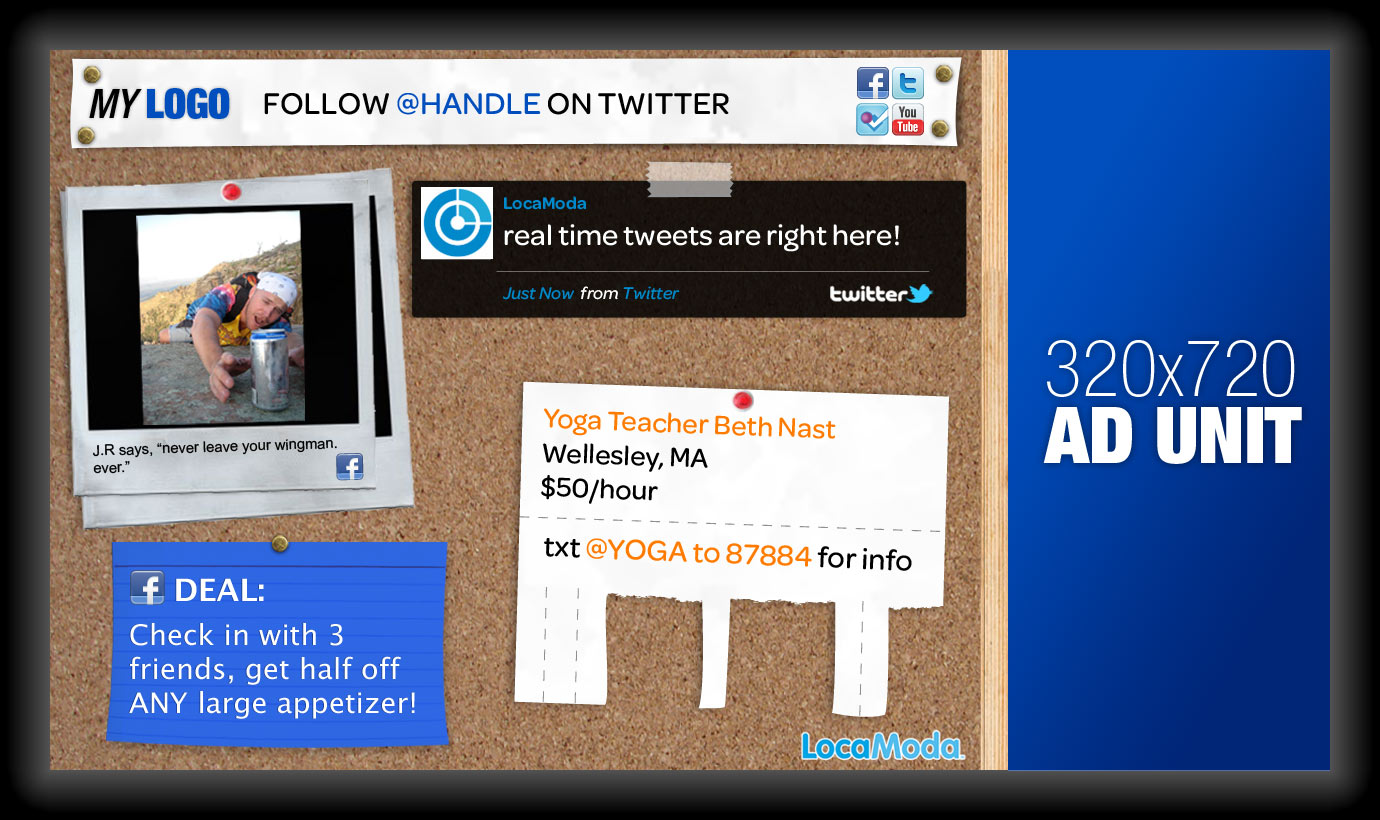
I rarely use this blog to blatantly plug LocaModa products, but I’m really excited about LocaModa Community Board, an application that we launched today. A link to the PR is at the end of this post, but I think there’s a more important strategic angle unfolding in the DOOH market that can’t be told in a product press release - so I wanted to blog about it here.

There are over 300 DOOH content management systems (CMSs).

That’s a problem that would get in the way of any market taking off.

Let’s be honest, brands, agencies and retailers really couldn’t care less about CMSs. And they certainly don’t want to have to wrestle with more than one. They want simple, non-proprietary, scaleable solutions. Ideally, a designer wants to build it once and know it can run everywhere.

We’ve been here before. The Internet took off with the invention of the browser which was simple, powerful and useful and provided a unified interface on top of proprietary operating systems.

I think a similar strategy has to unfold in DOOH to enable more frictionless distribution and greater scale. And I hope (for LocaModa’s strategic value) that it will happen via Community Board.

Community Board is also simple, powerful and useful and provides a unified interface on top of proprietary operating systems.

The value of community boards is in their connection to real people. A digital version of a community board takes a familiar metaphor and enables locations and brands to reach those communities. Packaging a DOOH application this way, makes it easier to understand by the entire value chain. It provides a utility that venue owners and brands can relate to. Brands can also be confident that their ad units (passive, active or interactive) will work in a consistent manner on all community boards, regardless of network capabilities. And community boards have a place and value in multiple verticals - health clubs, grocery stores, pharmacies, retail, offices, cafes, quick serve restaurants…

Very few companies are as focused on making DOOH applications and ad units work across multiple networks, multiple CMS, multiple channels - That’s what LocaModa has been resolutely focused on. As more and more DOOH networks seek mobile + social + local solutions in order to engage audiences and attract interactive media dollars (i.e. survive) they MUST adopt non-propriatary solutions. Simply put, even the largest networks cannot operate as islands.

LocaModa Community Board is launching nationally on six networks and two premier brands have already purchased media for Q3 and Q4. I’m excited for this application and LocaModa - but also because I can see how the DOOH market can grow like the web via such unifying applications.

Hey, an entrepreneur has to have a BHAG (Big Hairy Audacious Goal) - mine is to enable The Web Outside. I think Community Board is a critical part of achieving that goal.

The official press release is here.

Share

Making social DOOH media work across different networks - each with different caching policies, content management systems and player configurations - is the stuff that LocaModans wrestle with every day. That’s challenging in and of itself, but we added the complexity of ensuring that future cross platform/cross channel apps are also easier to develop - without having to be a brain surgeon. So I’m happy that the big brained engineers at LocaModa have been busying themselves for a major release. Here are some details…

Key features:

· Messaging: Flexible and extensible message classification system - makes it easy for developers to add message types and/or message sources.

· Moderation: Enhanced moderation and filtering/curation options of content based on tags, words, phrases, profanity and users/accounts.

· Local Caching Support: Like the Energizer Bunny, we keep going and going! LocaModa apps now support both Network Outage Mode (Network/Internet failure while SWF is playing) and Offline Mode (No network/internet connection prior to/up to SWF launch time). LocaModa apps now have Network/Venue options for configuring offline storage of device info, configuration info, messages, and assets using a pragmatic approach with a garbage collection system to ensure minimal device overhead. Due to the different caching policies of every DOOH network, this feature has been pretty challenging - hats off to the team who have persevered to make this work across multiple networks, OSs and CMSs. This is a big deal in my humble opinion.

· Enhanced Application Configuration: Again, regardless of a network’s CMS, OS and their screen specs, networks and/or venues can configure LocaModa apps and aspects of their appearance easily. For example, we include a configurable banner component that allows the network or venue to determine: the banner location, background, and transparency, the text font and color, and the rotation schedule. The banner and text autosize to the screen. Networks and venues can also configure the font, color and hang time of brand and user generated messages. No big deal for any competent CMS these days, but offering this flexibility for an application running on top of multiple proprietary CMSs makes a huge difference for venue owners or agencies that don’t want to have to learn about multiple DS systems just to change their messaging.

· Standardized Ad Units: We’ve been running standardized ad units across multiple networks for some time now, but now there’s more magic to the “write once run anyway” manner in which the same ad unit can resize in LocaModa applications regardless of network/screen configurations. We’re also introducing new sponsored ad units in response to great feedback from our Community Board application that enhances advertising opportunities and engages the audience. All apps and ad units now have an enhanced suite of analytics (Proof of play anyone?) and remote debugging tools.

· And not to mention a LocaModa SDK! (I said not to mention that!)

Some of these features have already begun rolling out on our latest campaigns. Stay tuned for more info in the coming weeks.

Share

As the crisis in Japan continues to unfold, getting electricity to essential services is understandably more important than keeping some of its digital out-of-home screens lit up.

I don’t want to suggest that any business challenges are more or less important than humanitarian ones, but just what would it take to make a DOOH network in Japan (or anywhere for that matter) so essential, it must be kept running?

Google succeeds via the utility of search, before it monetizes via advertising. Facebook succeeds via the utility of connecting friends and family, before it monetizes via advertising. Like Google and Facebook, DOOH networks need to provide useful services and applications to the environments in which they operate before they can be monetized for secondary purposes such as advertising.

One way DOOH screens in Japan could be more valuable is to display hyper-local real-time updates at locations where people are struggling to remain informed.

We don’t need a crisis to learn that DOOH screens must provide utility and value.

Share