Looking for something?


Posts Tagged ‘advertising’

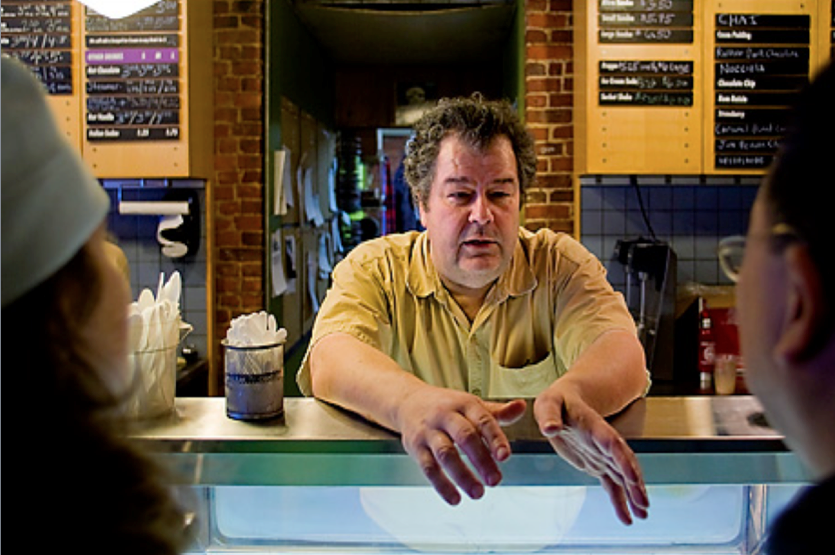
Meet Gus. He’s the owner of Toscanini’s in Cambridge, MA. This week, Gus became the proud owner of a Silver Apex Award in the Food and Beverage category, as mentioned here yesterday previously.

Today the LocaModa screen at Tosci’s (as it’s known locally) has 3,128 Foursquare check-ins from 1,077 people. Starbucks, a few minutes from Tosci (also on Mass Ave in Cambridge) has 1,570 Foursquare check-ins from 580 people. We consistently enable an increase of 30-60% more check-ins on LocaModa screens. That means something to Gus, because his screen effectively communicates with his customers in his cafe and beyond (we also have twitter feeds tagged #Tosci and photos that are emailed to [email protected] and text messages sent using @Tosci to our short code. All in all, an engaging customer experience that reduces wait time and fosters loyalty.

Hold that picture.

At this year’s DSE, I gave a talk with the long-winded title “The 10 Biggest Problems and Solutions for DOOH Networks Flirting with Social Media and Mobile Applications.” You can find my presentation here. In that talk, I mentioned Gus, and the problem that many place-based ad networks are so focused on their network and/or advertisers’ value propositions that they sometimes forget to focus on the venue challenges.

Let’s assume that a cafe like Gus’s has 200 visitors per day, each spending $5 i.e. $30,000 per month. It’s easy to see that even if advertising revenue via a place-based ad network screen is shared with the cafe, it’s highly unlikely to be a material percentage of the cafe’s revenue. We can show that even if we make some bold assumptions about potential ad revenue based on 200 people x a generous 15 impressions each and a $5 CPM = $450 per month to be shared between the network and venue.

The moral of the story for place-based ad networks? Love thy venue first. The cafe owner isn’t interested in the advertising piece of the equation, he or she is interesting in his customers. Reduce perceived wait time, improve the customer experience, increase loyalty (and related programs), extend marketing reach and engage the customers. Once a venue’s customers are engaged with the screen, then you can start to monetize that experience for advertisers.

Share

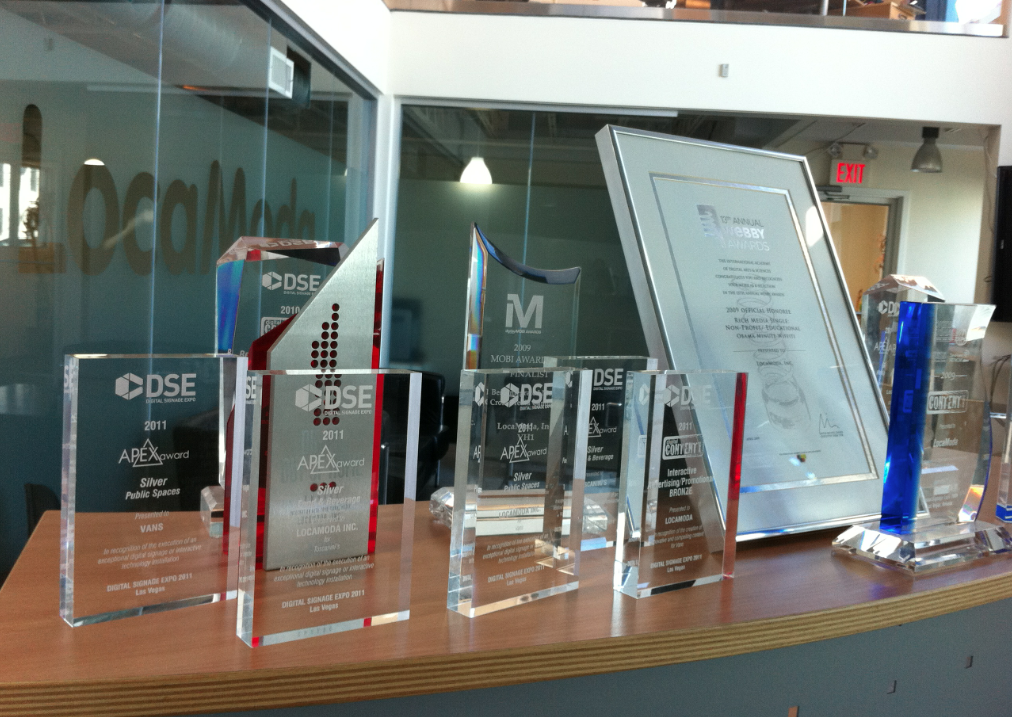
LocaModa returned home from this year’s DSE with some glass:

Gold Content Award for our work on Twitter Flow for our partners Zoom Media and Marketing.

Silver Apex Award, Public Spaces for our work on Vans BeHere.

Silver Apex Award, Food and Beverage for our work with Toscanini’s Full screen Foursquare.

Bronze Content Award, Interactive Advertising/Promotions, for our work on Vans BeHere.

We’d like the thank the fine folks at the academy DSE for selecting our technology. None of these awards would have been possible without the excellent work of our partners and the team in Cambridge.

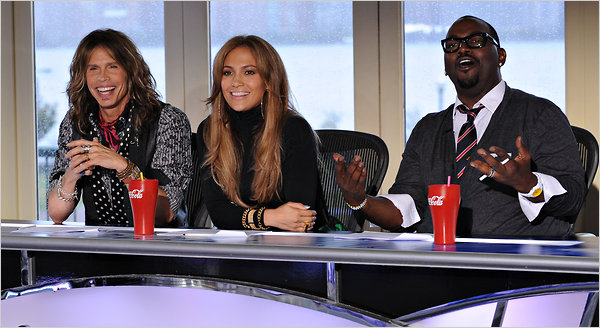
For those interested in red carpet fashion, my suit was Armani, Mr Nast was wearing Nat Nast, Mr King was wearing his favorite Dior gown and changed into Chanel for his song. Mr Stellato was wearing Gucci.

Share

All over the world, passive media is becoming interactive. But in America, we tend to ignore trends unless they happen here. In 2003, some five years after SMS was ubiquitous all over the world except USA, American Idol introduced SMS voting. Almost overnight, SMS took off in USA. It took a mass medium to validate what was already obvious to people outside USA. Communications is two way and passive media needs to get with the program.

This week, American Idol announced it was extending it’s interactively to the web with online voting via AmericanIdol.com and Facebook.

Here we go again. You’ve known for some time that passive media is being disrupted by the web, but what have most “passive media” businesses done about it? Apart from a few innovators, most have continued to do what they always have done - because learning something new and taking risks seemed to be the harder option. But now that more old school businesses are doing something about it, being interactive has tipped.

Interactive is the new passive.

Passive media has to connect to the web to be more accountable, and to be where the audience is. And now, it’s mainstream, it’s do or die.

To be more relevant, engaging and accountable, DOOH businesses must connect to real time sources like Twitter and Facebook, Foursquare etc. That means dealing with content curation, moderation and accountability at scale. That’s a big problem to deal with.

LocaModa has been banging on this drum for four years. It’s certainly been painful to be that early - but the advantage has been that we’ve patented solutions directed at connecting DOOH to the web and social streams. Make no mistake, DOOH has it’s own unique challenges - e.g. different screen formats, network ops, granular content distribution and rules - but these have all been solved. So no more excuses.

We think the future is connected. Apparently so does American Idol. Maybe more people will recognize this now.

Share

Well they do say “What happens in Vegas, stays in Vegas” and my first impression of Digital Signage Expo 2011 in Vegas was that much of it might have stayed there from previous years’ shows. Row upon row of screens, PCs, mounts, and content that was indistinguishable from the content that we try to avoid in our daily travels. But first impressions don’t always count. This year was different.

Now I have my own lens on things - and admittedly it might be rose-tinted around anything that dares to be related to Web 2.0 rather than TV 1.5, but the difference I noticed wasn’t on the show floor, it was the multiple discussions driven by DOOH sales opportunities dependent on strategic social media and mobile integration.

When a client needs and asks for solutions that connect to their customers you listen if you want to win (or keep) their business. You can’t pay lip service to being a digital solutions company and get away with a passive product that extends marketing only as far as the viewing range of a screen. So this year, I was encouraged to hear leading DOOH companies asking us to help them address their customers’ requirements for integrated social media solutions.

Transitioning a DOOH business from a narrowcasting mindset into a “connected” solutions business (in the Web 2.0 sense), will be challenging for many - but I’m happy to see a more wide spread desire to make that transition.

Share

Continuing the theme from my last post, the #4 problem (I’m not going to go through all 10 problems here - I’ll post the presentation after DSE) is the fear of social media.

Anyone pitching social media + DOOH will typically hear push back around the issue of moderation and/or losing control of the brand.

Fear of social media is a poor EXCUSE for not deploying it. Good moderation tools are effective and inexpensive (typically less than 5% of media budget). And the tools work. So stop with the excuses - do you want to leverage social media or don’t you?

Here’s a quick check list for a moderation and curation tools:

• Scalable
Make sure it is web-enabled, can scale to thousands of messages and multiple moderators at different sites/timezone if needs be.

• Real time
Make sure the software delivers real time responsiveness. Messages on DOOH screens often (but not always - download the free white paper detailing Passive, Active and Interactive place-based social media applications) need to be time sensitive to ensure the best user experience.

• Filters and “not tags”
Every brand will have it’s own moderation policies and list of topics/words that it doesn’t want to see on its screens or websites. This isn’t just about abusive language, but also undesirable brands, competitors etc.

• Remove web attributes.
Filters should also be able to remove web links, retweets etc - artifacts from the web that really don’t work well on public displays.

Inevitably the issues around moderation and curation can seem off-putting to clients without experience in this area. However, emphasize that these services can be managed effectively and inexpensively. Your clients are coming under pressure to find social media solutions because the market is demanding it and their competitors are moving in that direction. Hopefully the competitive threat outweighs the fear of the unknown.

I’ll be talking about this issue and many other at DSE next week on two panels and two workshops. You can find the details of these events at LocaModa.com/news Hope to see you there.

Share