There are few questions that get me as steamed up as “Will smartphones kill DOOH?”
Video didn’t kill the radio star - at least not all of them. TV hasn’t killed Cinema, the web hasn’t killed TV and smartphones will not kill DOOH. All screens are evolving.
Of course as a DOOH advocate, I would say that. And I’d probably add - “Smartphones will compliment DOOH” - but I thought the question deserved being laid to rest once and for all. Here are my top ten reasons why smartphones won’t kill DOOH - EVER:
1. Targeting. Smartphones are not a replacement for advertisers seeking a targeted out of home audience. Advertisers cannot push messages to phones (and good thing too) not only because that would be a bad user experience but also because of the CanSpam Act that legally prevents them doing so (See #2 re Push Notifications).
2. Push Notifications and Geo Targeting is NEVER a solution. The often described use-case where a user is walking past Starbucks, and receives an offer for coffee on their phones (smartphone or otherwise) deserves to be debunked. As mentioned in #1 - messages can’t be pushed to users without their explicit permission/opt-in. If that message is an update inside a smartphone app, not all users will have push notifications enabled, so will be unable to receive updates if the app isn’t running. After receiving more than a couple of offers, how many people do you think will keep that feature on? My guess is that unless the app is capable of mind reading, it’ll be turned off like pop-ups on browsers. (Internet Explorer 6+, Firefox, Opera, Chrome and Safari all block pop-ups by default.)
3. Location-Based Services (LBS) are not the enemy. LBS on smartphones such as Foursquare, Gowalla, Facebook Places are great fun and potentially valuable services for locations. The primary users for these services today are consumers not locations. The LBS companies want to address that, but dealing with thousands of stores is a very different business to dealing with millions of consumers. Some enterprising store managers are adopting LBS applications - offering discounts to mayors etc, but many do not have the time or understanding to properly leverage the power of LBS. DOOH has an important role to play here. DOOH screens are much more likely to be looked after by store managers who see them every day than a profile page on the web. Every time LocaModa displays Foursquare on a venue’s screen, that venue sees increases in user engagement. Consequently, it is much more valuable for the venue to promote their offers on their DOOH screen (perhaps within the DOOH version of their LocaModa Foursquare page).
4. Discovery. Smartphones do not provide a unified media distribution solution for brands and agencies. Apps and ads need to support multiple platforms - Android, iPhone, Symbian, RIM, HP/Palm. Consequently, it’s not easy to get a message to multiple handsets and know that message is going to be seen. Will that message be an iAd or a banner insider a Twitter client? Will the app be available in the Apple app store or Android marketplace? If it is, how will it be discovered? With over 300,000 iPhone applications to choose from, what are the chances that the user will discover and download the app?
5. Availability. Mobility and Availability are different considerations. When consumers are mobile, they typically have a purpose and are less receptive to stopping, getting a phone out of their pockets, and clicking on something to browse or play. In a mobile-mode they are however exposed to DOOH and OOH. Once a person’s mode changes to “dwelling”, they are open to environmental distractions such as menus, posters, DOOH screens etc. Of course many such environments are so unenageing that consumers do start to “self entertain” - read books, newspapers, iPhones etc. BUT that does not mean that the environment has disappeared. If the most entertaining or information-rich screen is not in front of them, the user might have other options, but those options are only attractive if those screens are more readily available than the location’s screens. For example, if a station had no obvious information, a user would most likely wander around for a few minutes seeking it. The act of pulling out a phone, finding an app or website, searching for the right information etc is more than a few clicks away and might be less available that find the information at the location.
6. Locations Are Users Too. DOOH is not just there for audience entertainment, but for information, reduction of perceived wait time, advertising etc. The location can’t replace it’s menu boards with an assumption that all of its customers will have smartphones.
7. The 3 Click Rule. UI designers will often tell you that between 30% to 60% of users abandon a process with every click. To be conservative let’s assume the lower number, that still means you have only 2-3 interactions before you’ve lost most of your users. A smartphone will not satisfy all opportunities to inform or entertain in less 3 interactions - and as long as there are more readily available solutions on DOOH, many people will not seek alternatives.
8. Multi-channel. The smartphone screen isn’t the only screen competing for a user’s attention. With mobile, computers, TVs, cinemas and DOOH, advertisers are taking a multiple channel approach to their messaging. This means that ultimately ALL screens will be connected. Rather than a one size fits all approach, the media landscape is actually becoming more fragemented and micro-targeted as a result. This means that the phone screen is often part of a 360 degree solution - it’s not the entire solution - and neither is DOOH.
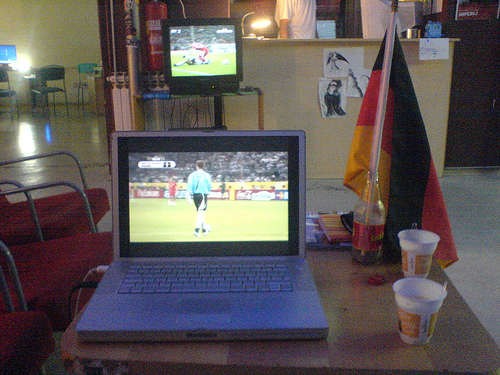
9. Attention is the currency. As far as screens go, people are attracted to the most compelling screen that addresses the context of that moment. If a DOOH screen is engaging, the user will notice it, if not, the user might be tempted to play with her iPhone. However, it’s as ridiculous to suggest that smartphones will kill DOOH as it would be to suggest that smartphones will stop people noticing the opposite sex. OK - I accept that most DOOH is not as interesting as the opposite sex - but that isn’t a smartphone problem, it’s a DOOH problem. And size matters - a large attractive screen should be more compelling than a small attractive screen. The challenge, as always, is to ensure the large screen is actually compelling.
10. Only Bad DOOH Will Kill DOOH. This is really repeating #9 but I think it’s worth repeating. The only real threat to DOOH (and it’s a big threat) is bad DOOH.
So the next time anyone suggests that smartphones will kill (or bypass) DOOH, you take your pick from the above answers.