Looking for something?


Posts Tagged ‘DSE’

Well they do say “What happens in Vegas, stays in Vegas” and my first impression of Digital Signage Expo 2011 in Vegas was that much of it might have stayed there from previous years’ shows. Row upon row of screens, PCs, mounts, and content that was indistinguishable from the content that we try to avoid in our daily travels. But first impressions don’t always count. This year was different.

Now I have my own lens on things - and admittedly it might be rose-tinted around anything that dares to be related to Web 2.0 rather than TV 1.5, but the difference I noticed wasn’t on the show floor, it was the multiple discussions driven by DOOH sales opportunities dependent on strategic social media and mobile integration.

When a client needs and asks for solutions that connect to their customers you listen if you want to win (or keep) their business. You can’t pay lip service to being a digital solutions company and get away with a passive product that extends marketing only as far as the viewing range of a screen. So this year, I was encouraged to hear leading DOOH companies asking us to help them address their customers’ requirements for integrated social media solutions.

Transitioning a DOOH business from a narrowcasting mindset into a “connected” solutions business (in the Web 2.0 sense), will be challenging for many - but I’m happy to see a more wide spread desire to make that transition.

Share

Continuing the theme from my last post, the #4 problem (I’m not going to go through all 10 problems here - I’ll post the presentation after DSE) is the fear of social media.

Anyone pitching social media + DOOH will typically hear push back around the issue of moderation and/or losing control of the brand.

Fear of social media is a poor EXCUSE for not deploying it. Good moderation tools are effective and inexpensive (typically less than 5% of media budget). And the tools work. So stop with the excuses - do you want to leverage social media or don’t you?

Here’s a quick check list for a moderation and curation tools:

• Scalable
Make sure it is web-enabled, can scale to thousands of messages and multiple moderators at different sites/timezone if needs be.

• Real time
Make sure the software delivers real time responsiveness. Messages on DOOH screens often (but not always - download the free white paper detailing Passive, Active and Interactive place-based social media applications) need to be time sensitive to ensure the best user experience.

• Filters and “not tags”
Every brand will have it’s own moderation policies and list of topics/words that it doesn’t want to see on its screens or websites. This isn’t just about abusive language, but also undesirable brands, competitors etc.

• Remove web attributes.
Filters should also be able to remove web links, retweets etc - artifacts from the web that really don’t work well on public displays.

Inevitably the issues around moderation and curation can seem off-putting to clients without experience in this area. However, emphasize that these services can be managed effectively and inexpensively. Your clients are coming under pressure to find social media solutions because the market is demanding it and their competitors are moving in that direction. Hopefully the competitive threat outweighs the fear of the unknown.

I’ll be talking about this issue and many other at DSE next week on two panels and two workshops. You can find the details of these events at LocaModa.com/news Hope to see you there.

Share

Digital Signage Expo is coming up next week in Las Vegas and I’ve been asked to speak on a couple of sessions as well as give a couple of “lunch and learn” workshops. (You can see the various upcoming events that we’re involved with here.)

One of those sessions (S29 for those of you wanting to come) has the catchy title “The 10 Biggest Problems and Solutions for DOOH Networks Flirting with Social Media and Mobile Applications” and I thought I’d post a few slides and comments here.

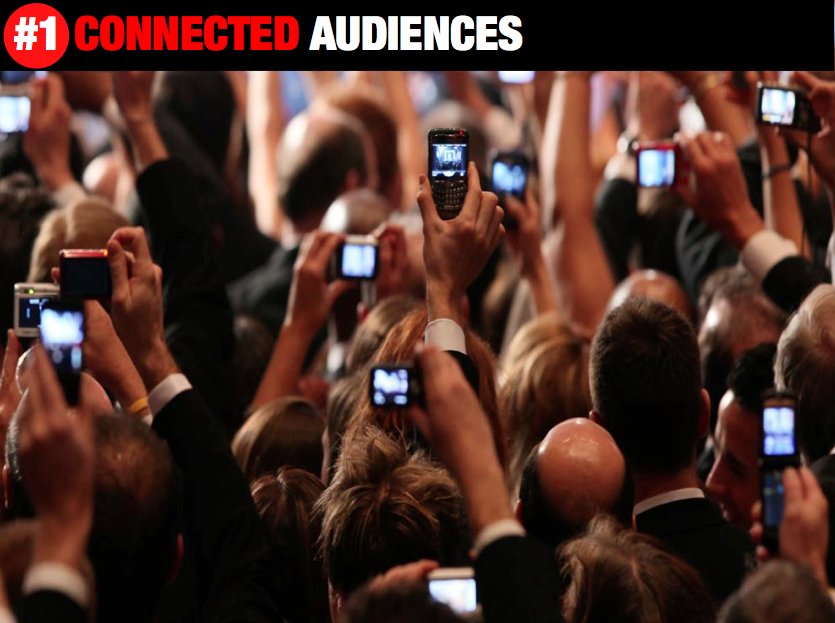
#1 “Connected Audiences.”

It’s remarkable in this day and age that so many companies in the DOOH market don’t really appreciate the extent to which connectivity will define their future. I still get asked if social media is a fad. Really!

Twitter is an easy target for nay sayers. It’s easy to assume that Twitter is for time wasters - just like it was easy to laugh at the web when it first emerged. But that perspective is blinkered and shows a lack of understanding for the power and disruption of social platforms. Look no further than the events in Egypt last week to see the potential of social connectivity.

An average 20 minutes on Facebook in 2010 gets over 15 million posts, 10 million comments and 2 million photos. (Source: AllFacebook.com
)
Social networking isn’t just for teenagers - even though Justin Bieber has more than 6 million Twitter fans and over 1 billion YouTube view. Social networking site usage grew 88% among Interent users aged 55-64 between April 2009 and May 2010. (Source: Pew Research)

The fundamentals are that human beings like to connect - and any technology that makes that connection richer is likely to succeed. The opposite is true - i.e. technologies (or regimes) that cannot leverage the richest connectivity are marginalized and eventually fail.

It’s not a leap to apply this thinking to place-based networks - it’s common sense. We have an amazing potential to leverage connectivity to social media, displaying it in places where people shop and socialize, to influence sales, marketing and user experiences - and in the process, grab attention and keep our screens relevant.

Share

vancouver_goldmedalWe may not be heading to Vancouver in February, but we are heading to Vegas to pick up some hardware of our own.

We were psyched to find out that we’re finalists for both an Apex Award for our work on GeorgeTweets and for a Content Award for our cross-channel campaign for VH1′s The Great Debate. The awards will be handed out at the Digital Signage Expo in Vegas on February 24th.

Congrats also go to our network partner Zoom Media & Marketing, who share the spotlight with us for both of these honors!

Share

ykos - 13Richard Leibovitz, Editorial Director at Digital Signage Expo, posted a great question on the LinkedIn 2010 Educational Faculty Group Forum about the viability and implementation of a Twitter backchannel at conferences and events.

He asks:

DSE is looking for ways to engage the Twitter backchannel as part of the educational conference discussion at DSE 2010. Please join the discussion by sharing any experience you’ve had with attendees tweeting in conference rooms and any suggestions you might have for using these tweets in a positive way… The other question is whether we ask our session moderators to monitor tweets as a way to gather questions for the speakers, or whether the speakers themselves should be moderating tweets during their sessions so they can respond directly to questions?

I wanted to post my thoughts here since many The Web Outside readers may not be involved in the DSE site (but you should be!)
***

I think one of the main sticking points on the moderation discussion is directly related to the definition of ‘backchannel’ itself. The concept of a Twitter backchannel has recently come to the fore of many conference and event planning discussions, but the term has unfortunately taken on a dual definition that’s at odds with itself.

In one camp, event organizers view this backchannel as a means of providing additional context for the event – an ambient reflection of the happenings on the show floor.

In the other camp, the backchannel is understood as a direct means of communication with the speaker or event organizers, a ‘DM’ to the topic/speaker currently at the helm.

The problem with this twofold definition is that each use case begs for entirely different moderation protocol. In the former case, an auto-filter eliminating profanity (and all of its creative permutations!) and racial slurs may be enough in many instances. In the latter, specific context plays a much larger role, and cherry-picking content is often the only route to guaranteeing relevant (if not ‘appropriate’) messages are displayed. It’s actually quite similar to the struggle that contextual advertising software faces.

At LocaModa, we’ve addressed these two scenarios with a moderation system that allows for:
1. auto-filtering at G, R, X ratings
2. human moderation in a queue format
3. a ‘curation’ system that allows for cherry-picking of content in terms of time/relevance

For DSE, I think a Wiffiti screen (with additional hashtagged Twitter and Flickr streams) would work well as an ambient screen in the networking area, and would give the options of auto-filter with optional human moderation if the self-advertising gets out of hand.

Using the screen as a specific pairing with a speaker is always a dodgier situation, especially when conferences attempt to pigeonhole its use into a standard Q&A format. This backchannel shouldn’t replace human interaction, but rather, enhance it. As an ambient channel, Wiffiti can be a very powerful tool. As a replacement for rote Q&A session transcription, I’d recommend sticking with manual entry Powerpoint.
***

I’d love to hear other industry views on this topic… Do you think some of the resistance of the real-time format is directly connected to the conflicting definitions of how a backchannel should be most effectively framed and viewed?


Share