Looking for something?


Archive for the ‘Featured Article’ Category

Nearly two years ago (Feb 2008), LocaModa launched Jumbli - a mobile and web based word game that was the first cross-channel game to use DOOH and Facebook. Today, Jumbli is still going strong on over 1,000 U.S. bar and cafe screens and in Times Square.

When we launched the game, the first sponsor was AT&T and during their sponsored month, we saw over 300,000 plays and reported that the top “interactive cities” (measured by the percentage of total mobile plays) were: LA 18%, Boston (17%), New York City (17%), and Chicago (10%).

That’s old news - but hang in there… We have Jumbli running on a loop on one of the screens at Loca HQ, and it’s surprising that people are still playing the game (90% via Facebook) from all corners of the world and at all times of the day and night.

Just how much time are the top players spending on Jumbli? As you can see from the above table (click to enlarge), the top player has so far spent the equivalent of 48 days of continuous play!

That’s a lot of time for a word game invented for DOOH screens.

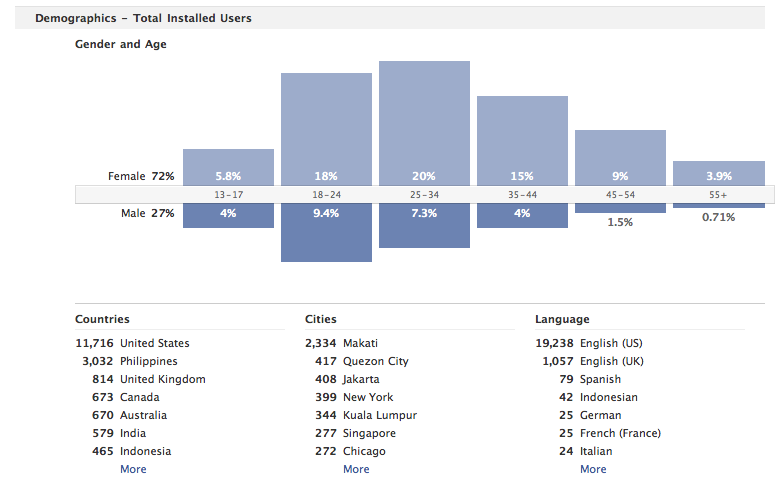
More interesting info on Jumbli can be seen from the Facebook demographic data above (again, click to enlarge) which tells us that outside of USA, Philippines is the top country, then UK. And the top cities are Makati Quezon City and Jakarta, followed by New York. Well that was unexpected!

By the way - KenRandall, ranked #9 in the Jumbli top 10, is my Dad, and now I know he spends way too much time most mornings (from London) being distracted by Jumbli. 28 days to be precise!

Share

LocaModa’s typical work involves enabling channel partners’ place-based social media apps (for example the Sports Bites application for Zoom Marketing and Media and the NYTimesToday.com Twitter application for RMG) and building fully integrated advertising campaigns for brands such as AT&T, Vans, Verizon etc.

But we also have a self-serve business over at www.wiffiti.com (soon to be renamed to fall under the LocaModa brand). The site’s primary purpose is to help end-users build and spread simple place-based social media apps. And it also gives us insights into how people are using our platform.

The result? Today the site clocked its 45,000th application, with over 50 apps built by midday today! A surprising number of the applications have been built by teachers seeking a more direct and fun way to connect to their students (see this Web 2.0 EDU blog post on “5 Way To Teach With Wiffiti In The Classroom”).

Some screens have been used in churches for similar reasons - audiences of all types clearly want to connect. The site also helps professional users “try before they buy” (that’s the “freemium” business model) for use at conferences (here’s an example from the Mashable Media Summit), events, concerts and a even stand-up comedian!

Self-serve equates to roughly 10% of our business. There will always be a requirement for custom applications and professional services for larger DOOH networks and campaigns, but we have to wonder if that percentage is indicative of the wider DOOH opportunity.

Share

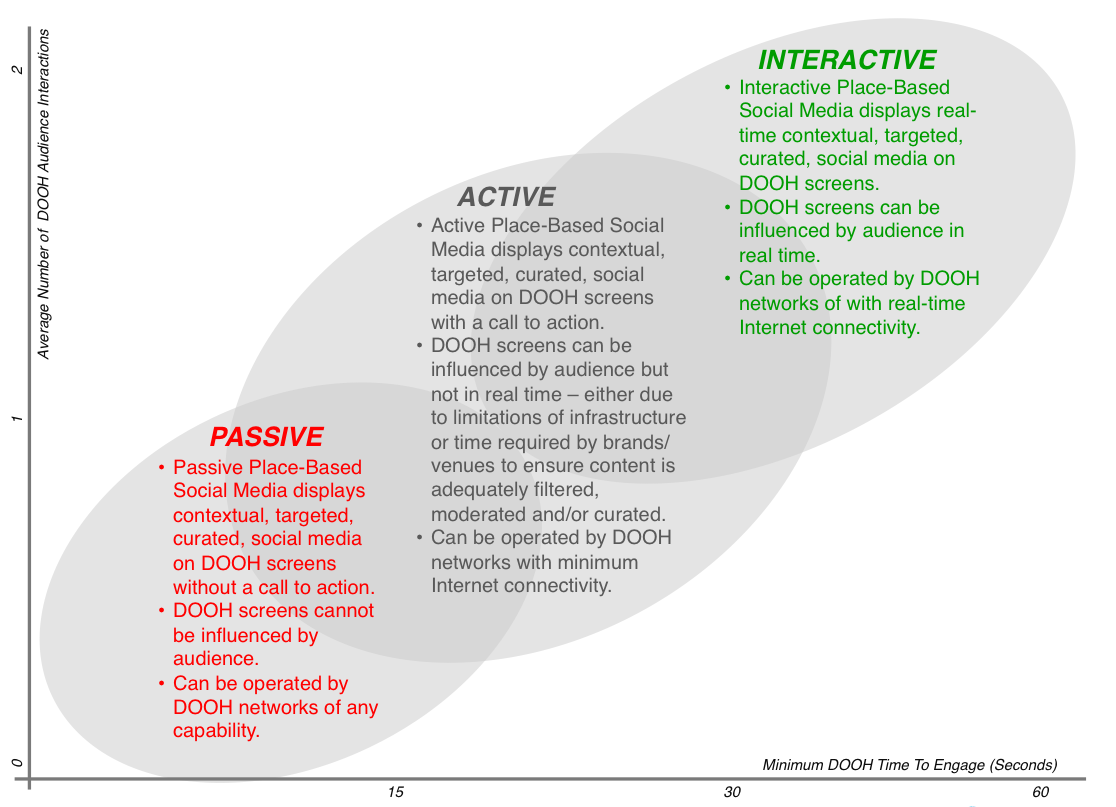
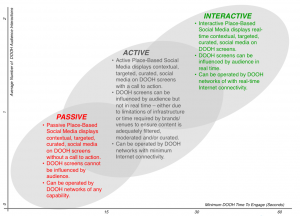
Fig.1. Place-Based Social Media Modes (Click to enlarge).

I’ve just returned from a road trip where I’ve been explaining the different types of place-based social media to brands, agencies and networks. I’m committing my talks to a white paper, but in the meantime, I thought it would be useful to post parts of it here.

This first post describes three types of place-based social media engagement; Passive, Active and Interactive.

Place-based social media does not have to be real-time, interactive or require a specific lean-forward mode of engagement. Understanding how to optimize out of home engagement requires an awareness of the end user’s availability (to consume content) and ability to participate as well as an appreciation of the environment for their engagement, the Digital Out of Home network’s capabilities and the stakeholder’s objectives. Those considerations map to three modes of out-of-home engagement; Passive, Active and Interactive (See Fig.1), each of which maps to distinct applications that can optimize the engagement strategy for locations (retail, hospitality, fitness, health care etc) and brands.

PASSIVE PLACE-BASED SOCIAL MEDIA
Passive place-based social media is best used where the dwell time and or the available time on the DOOH content loop is under 30 seconds. The key attributes of passive place-based social media are:
- It displays contextual, targeted, curated, social media on DOOH screens without a call to action.
- It cannot be influenced by the DOOH audience.
- It can be operated by DOOH networks of any capability.
- As its name implies, passive place-based social media, without a call to action or enough time to engage, does not support any DOOH user interactions.

ACTIVE PLACE-BASED SOCIAL MEDIA
Active place-based social media is best used where the dwell time and or the available time on the DOOH content loop is at least 30 seconds. The key attributes of active place –based social media are:
- It displays contextual, targeted, curated, social media on DOOH screens with a call to action.
- It can be influenced by the DOOH audience but not in real time – either due to limitations of infrastructure or time required by brands/venues to ensure content is adequately filtered, moderated and/or curated.
- It can be operated by DOOH networks with minimum Internet connectivity.
- Active place-based social media, with a call to action and up to 15 seconds to engage, typically has enough time for only one DOOH user interaction.

INTERACTIVE PLACE-BASED SOCIAL MEDIA
Interactive place-based social media is best used where the dwell time and or the available time on the DOOH content loop is at least 60 seconds. The key attributes of interactive place-based social media are:
Displays real-time contextual, targeted, curated, social media on DOOH screens.
- Can be influenced by the DOOH audience in real time.
- Can be operated by DOOH networks of with real-time Internet connectivity.
- Interactive place-based social media, with a call to action and at least 60 seconds to engage, typically has enough time for more than one DOOH user interaction and supports more complex interaction models.

In 15 Seconds Or More (Part 2) I’ll cover the seven steps in the user engagement path.

Share

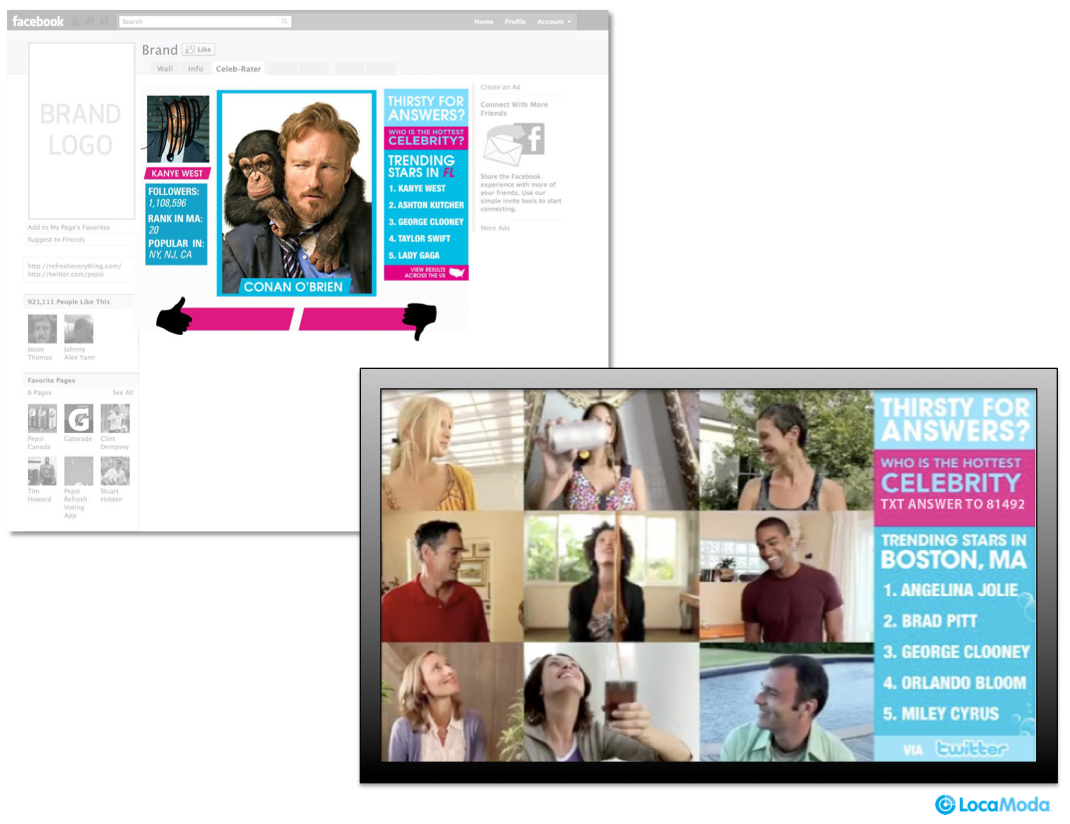
Example “Trending Celebrities” Place-Based Social Media App

This morning LocaModa announced that we have signed a agreement with Premier Retail Networks, Inc. (PRN) to deliver cross-channel social media on their Checkout TV® Network in supermarkets.

As mentioned in the press release here, PRN and LocaModa will jointly develop a suite of cross-channel ad units designed to enhance customer engagement at checkout by integrating mobile and Web with digital place-based media. PRN’s advertising solutions now include the ability to display filtered, localized social media components with curated user-influenced content and trending topics collected via mobile texts, Twitter and Facebook. The new place-based ad units are measurable and connect PRN’s Checkout TV® Network to mobile phones and social networks. The ad units can be configured to display the most important shopping items according to local customers’ comments. Audiences can participate via mobile phones, Facebook, Twitter or brand Web sites, and see aggregated results on the Checkout TV® Network screens as well as online.

The above screen shots show one example of a place-based social media application that displays the popularity of celebrities trending locally, determined by shopper mobile votes, on-line Facebook votes and changes in the number of fans for celebrity Twitter accounts. In the lower right screen shot, the place based social media ad unit for the Checkout TV Network displays near real-time results on a branded right hand panel of the DOOH screen, complimenting a video ad unit.

What our recent announcements with Posterscope and FUJIFILM Imagetec have in common with today’s news is the tsunami-like demand from brands and agencies for mobile and social media connectivity.

As Cathy Stauffer, PRN executive vice president, market development states in the press release: “Today’s audience enjoys media that is socially connected. LocaModa’s platform helps us create a dialogue between our advertisers and consumers through content displayed on Checkout TV® Network screens in supermarkets that can be continued on other platforms, helping to contribute to even deeper brand engagement.”

Anyone in a media-related business knows that they have to have a good answer when their customers ask them for “mobile and social media solutions.” As challenging as our industry can be (prize for understatement of the day goes to me!), it is telling when influential players across the value chain start to align on the message that “all screens are connected” and a strategy to “make sure we’re connected too.”

Now consumers can enjoy social media in line and on line. Someone should use that as a tag line!

Share


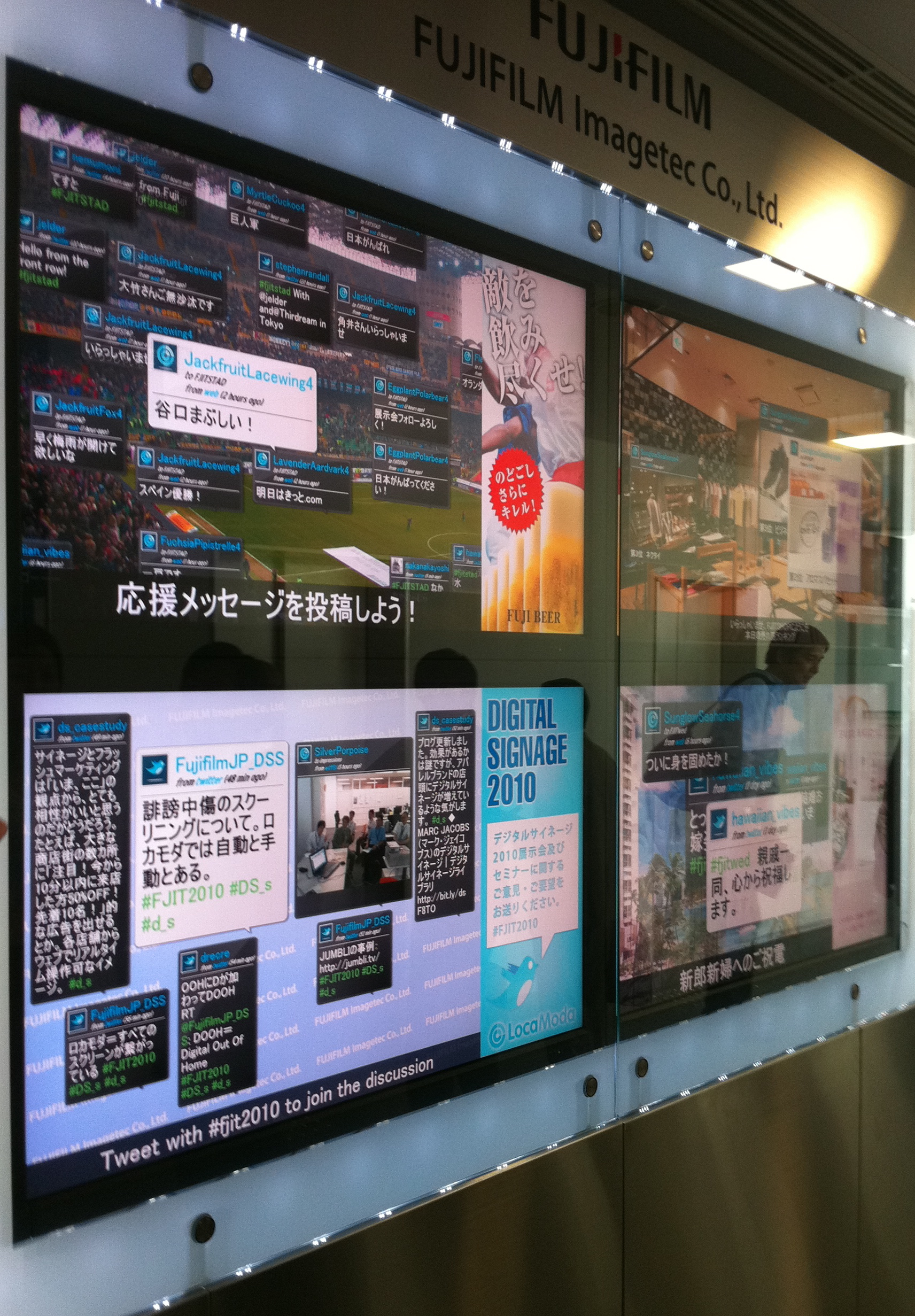
LocaModa Place-Based Social Media Screens At FUJIFILM Imagetec Co. Ltd.

I’m delighted to announce LocaModa’s relationship with FUJIFILM Imagetec Co. Ltd, a subsidiary of FUJIFILM Corporation. The press release can be found here.

I went to Tokyo earlier in the year to understand the potential of the market. Screens in stations, public spaces, stadiums, retail stores and even Karaoke bars are starting to be networked in interesting and innovative ways. Companies that for decades have provided the leading traditional advertising solutions for those spaces are now moving into digital solutions.

The recent success of Twitter in Japan has opened the market up to the power of social media. I commented earlier in the year that Shubuya Station is Foursquare’s busiest location for checkins. When I posted about that here, it had 65k checkins, today, barely 4 weeks later, that number is over 78,000.

Japan has for many years led the world in mobile technology and I have to say, their phones are still way ahead of what we typically see in US. However, the innovative but proprietary iMode framwork for apps and services that was standardized and directed by DoCoMo, Japan’s dominant wireless carrier has been rocked by Apple. The iPhone has almost single-handedley moved many Japanese companies to move to web-based mobile apps as their previous iMode sites look like postage stamps on an iPhone or Android device.

These facts all point to the web re-establishing itself as the backbone for services and media.

Companies such as FUJIFILM Imagetec are adopting web strategies in order to establish themselves as responsive and innovative solutions in the DOOH space. It’s a very exciting time, and we look forward to helping our partners develop leading edge solutions.

Share